Wednesday, February 14, 2024

Vasanta Panchami Saraswati Puja

Happy Vasanta Panchami. This is a day of Saraswati (सरस्वती) Puja.

A rare Saraswati temple exists in Koothanoor, Tamizh Nadu. Many Bhaktas have reported personal experiences of improvements in education after her blessings. This was the deity worshipped by court poet Ottakoothar, a contemporary of Kambar. While Kambar had composed the Ramayana in Tamil, it was Ottakoothar who composed the Uttara Kanda portion in Tamil.


Ottakoothar was the dumb (unable to speak) son of Kumbakonam Sarangapani Dikshidar. He spoke on Vijayadashami with Saraswati's blessings. In Tamil, she is called Then Kani vakadevi or Kalaimagal. Ottakoothar's early composition was the Saraswati Andathi. Andathi comes from the Samskritam Antha-Adi; a poetic form where the end of a verse is linked to the beginning of the next one.

Raja Raja Chozhan would donate a village to Ottakoothar, hence the name Koothanur to the village. This temple was built by Ottakoothar.

Ottakoothar's samadhi is in Veerabhadra temple, Darasuram, behind the Iravatheewar temple. The temple is poorly managed as expected by the government.


Kambar was also a Saraswati Bhakta. She got him out of a fix many times. Here is one famous episode.

The West celebrates the tragic romance of Romeo & Juliet. Bollywood repeatedly references Laila & Majnu. For Tamils, until at least the previous generation, it was Ambikapathi & Amaravathi, the princess (Rajakumari). Ambikapathi was Kambar's dashing son, a poet, composer, musician & a warrior.

Once when Amaravathi walked in the palace on flower petals, Ambikapathi praised her with the phrase: Veitha kaal noga, edutha kaal koppalikka. Meaning the flower petals are so hard that they hurt your feet, the petals are so hot that they burn your feet. The problem: he says this in full public view of the king's session, incensing the king. Kambar lies that there was a granny selling food in the hot sun & that his son was referring to her. The king sends soldiers to check & there is Sarawati, actually taking the form of a granny, making his words come true. 

In Hindu Sampradaya, the divine will ensure that any words uttered by a saint comes true. Hence, Hindus seek out saints & their blessings. The blessing of a saint can thus override Karma.

The Chera king requests Kambar for his Saraswati vigraha & installs it in his capital at Padmanabhapuram. Later, Maharaja Karthika Thirunal moved the capital to Thiruvananthapuram. Every Navaratri from then, she is taken in a royal procession from Padmanabhapuram to Thiruvananthapuram & returned. Nowadays, she even has police gun salutes. However, apart from Navaratri, Kambar's Padmanabhapuram's Saraswati surprisingly gets only a fraction of the visits of Koothanur.


Kites are flown in Vasantha Panchami celebrations.

During India's dark ages, a young saint, Haqeeqat Rai, was killed on Vasantha Panchami after his refusal to convert. The colonial British had imposed restrictions on the festival celebration. In 2007, the government of Pakistan banned the festival.


The Hindu civilization, with the loss of half the territory and loss of generational wealth, faces immense existential challenges. A toxic academia, media & entertainment push misinformation & disinformation in the guise of neutrality, much like Putana. With her blessings & knowledge, all hurdles can be overcome.

Monday, October 09, 2023

Dharma vs Jungle law

Dharmo Rakshito Rakshitaha.

If you protect Dharma, Dharma will protect you.

Nature's default law is Matsya Nyaya. Big fish eats little fish. Also known as Jungle law, where the strong will survive & the weak will perish. The young are ruthlessly hunted.

Humans inherently dislike Matsya Nyaya for the human society. Owing to compassion, we seek to protect the weak & the poor as well. This allows civilization to thrive, by allowing humans to think higher thoughts, philosophy & create beautiful art. This is only possible when survival & safety is guaranteed even if we are weak.

The alternative is a system where everyone, including the powerful rulers, voluntarily subject themselves to common rules governing all. This is one aspect of Dharma. In some Dharmic systems, the powerful subject themselves to even harsher rules.

When not restrained by Dharma, the powerful will prefer a Matsya Nyaya system. The powerful can get away using political & legal loopholes, hiring media, writing propaganda to influence public opinion, hiring top lawyers & assassinating witnesses or dissidents.

There are other systems such as Marxism which, on the surface, look like Dharma, since it professes compassion for the weak, hence the appeal. However, it is a Matsya Nyaya system in disguise, which will end up in Communist dictatorships with special privileges for the party members, ruthlessly suppressing dissent with Kulaks & concentration camps. Religious systems that 'compassionately' seek to save others from a fiery hell after death also end up as Matsya Nyaya systems.

All human societies throughout history will swing between a Matsya Nyaya & Dharma system, ending up somewhere in-between. This conflict is eternal.

It is up to all of us to do whatever little we can to setup a Dharmic system, to protect us all. This is an unfortunately an eternal constant task. No one can do it for us; we all have to do our bit. Else, we will see unpleasant Matsya Nyaya in action.

The price of freedom & civilization is constant vigilance, for there are always barbarians at the gates. Dharmo Rakshito Rakshitaha.

Thursday, July 06, 2023

Martial Arts Rahasya

The worship of BodhiDharma

7amm arivu Tamizh film: https://einthusan.tv/movie/watch/0598/?lang=tamil https://youtu.be/lYGoAZLbZh0 

1-3 minutes. 21-23 minutes.

The origin of Shaolin

BuddhaBhadra. 1st abbot of the Shaolin temple. 

BodhiDharma: 2nd abbot of the Shaolin temple.


https://www.facebook.com/trueindology.org/posts/pfbid027Hctmtn4xUjoCqc4bRrrBDXZqNFQY38snhSy3t7t2YjUCkeEo72FAXzj7nctE4Uql

"This painting from ancient Shaolin temple (China) depicts the Indian monk Buddhabhadra, who was the founder of Shaolin temple and its first priest, teaching martial arts to his Chinese disciple Sengchou.

Buddhabhadra founded the famous Shaolin temple in 496 CE.  According to Chinese primary sources, Buddhabhadra was a Brahman monk from South India who first came to the Chinese capital Luoyang.

The Chinese Emperor Xiaowen offered to provide  quarters inside the royal palace for the Indian monk. But Buddhabhadra declined this offer. He set up an Ashrama on top of Mount Song which later came to be known as Shaolin.

In this painting, the dark skinned Indian man is Buddhabhadra and his Chinese disciple Sengchou learns martial arts from him.

Source: The Bodhidharma Anthology (translation) The Earliest Records of Zen, Jeffrey L. Broughton; The Shaolin Monastery: History, Religion, and the Chinese Martial Arts", University of Hawaii press 2008"

Buddhabhadra came to China on 464 CE and Established Shailon Temple in 496 CE After Preaching Buddhism for 32 Years.

Bodhidharma Was Born in 483 CE.

Marma Kalai

"Indian" Tamizh film on Marma kalai. https://einthusan.tv/movie/watch/0066/?lang=tamil https://youtu.be/rUyVYT0IUyo 3:30-3:50

Ayurveda documentary of demo of goat paralyzed & removal of paralysis. https://youtu.be/uvG_WtRvvOk "Art of Being": Ayurveda documentary by Pan Nalin 


Used for therapy. Originally Acupressure. Later developed into Acupuncture.

The Ban

Pazhassi Raja

https://youtu.be/ccbp0_ZqMBY?t=160 


https://www.youtube.com/watch?v=acJFxAoXYDk 3:02-3:03

Oral history: Kalaripayattu banned after the Kottayathu war in 1804. No primary English sources on ban. The colonial British burned a lot of records when they left. Many Gurus practiced in secret & came public after India's independence, which is the secondary source for the ban.

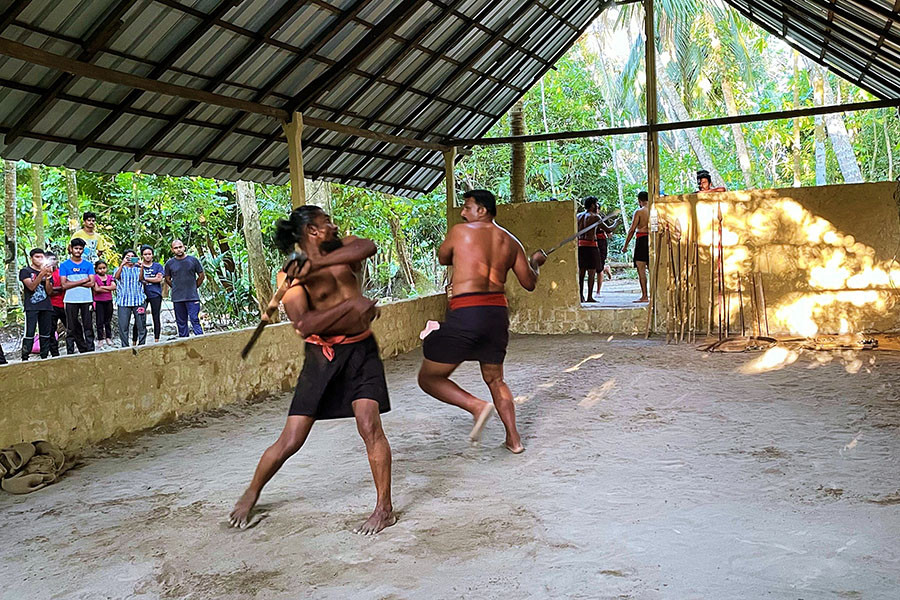
Oral & written Sampradaya: KalariPayattu (combat place+fight) founded by Parasurama. 

The Preservation

Gurukulams preserved the Vadakkathan (northern & central) Kalaripayattu art in secret, practicing with trees. Revived after India's independence. 

Shrines (Poothara):

  1. The Ganapathitara
  2. The Ayudhathara, which is dedicated to Shiva (also called Ayudhabairavan)
  3. The Gurutara – a small platform in remembrance of all past Gurus & current Guru.
  4. A small set of seven steps representing the seven chakras. 

Final training: Marma kalai & Rahasya Mantras. Safety precautions taken.

POOTHARA PRANAMAM (SALUTATION OF KALARI PAYATTU)

The seven presiding deities of Kalari comprise the seven steps of the Poothara. 
  1. The first step is that of Vignesha or Ganapathi at the base of the Poothara indicating strength & initiation.
  2. The second step is Chandika or Bhumi or Parvati (Earth Power) giving patience of earth. 
  3. The third step is of Vishnu for Agnisakti or commanding power. Vishnu has the Chakra as his weapon and its rotation destroys all enemies. 
  4. On the fourth step is Vadukisca or lighting. Speed & Posture (Ayudha parasakthi). 
  5. On the fifth step is Tadaaguru the power and blessings of the guru (Gurusakthi). 
  6. And on the sixth step is Kali in her Raudra aspect. Here, you get this special power of fury. 
  7. Finally, at the seventh is Vagastha-purusha where you get the power of voice or sound. Making certain noises, one can terrify the opponent like an animal.
A man who perfectly knows all these seven and keeps his mind always concentrated will be able to have superior Manasakti.

Ashoka film: https://einthusan.tv/movie/watch/1170/?lang=hindi 51:35-53:10

The Myth-Jackie chan: https://youtu.be/V7YYYTSkiJ8 

The Last Legion with Aishwarya Rai, treated the art with respect: https://youtu.be/5HIVRnF2CzE 

Magadheera: https://youtu.be/3M3irOF2ai4 

Adimurai

South Form (Then/Therku): Adimurai. Varma Adi, AdiThadi, Chinna Adi.

Origin: Agasthya. Practiced by Siddhas, Siddha medicinal system.

64 "practical vital spots" (abhyasamarmmangal): used only in danger. Knowledge may be passed down only to a Shiva Yogi. 
Sri Bhadrakali Mantram: chanted without error, can defeat the enemy.

Adimurai movie: Pattas. https://einthusan.tv/movie/watch/27KY/?lang=tamil 1:28:00-1:35:00 Wanted recognition by the Indian government.

Kalaripayattu from Kerala, Mallakhamb of Central India, Gatka of Punjab and Thang-ta of Manipur recognized as a sport in March 2021 by the Indian government. Multiple local indigenous martial arts still struggling & kept alive by a few practitioners. May go extinct without patronage.

AngamPora

SwarnaDvipa / Simhala / Tamraparni (Now called Sri Lanka). Settlers from Kalinga (Odisha). Simhala similar to Oriya.
AngamPora, banned by the colonial British in 1818. Practice punished by gunshot to knee. Preserved in secrecy. This lends credence to the claim of the ban by the colonial British in India.
Ban lifted by the (now independent) Sri Lankan government in June 2022. Colonial legacy persists & it takes time to decolonize.
Practiced in Buddhist shrines. Final rite of passage in a Buddhist temple. Respect to Guru parampara. Includes Marma Kalai.


Flexible sword: Urumi

Ashoka film: https://einthusan.tv/movie/watch/1170/?lang=hindi 7:50-8:40 51:35-53:10

Junglee film: Vidyut Jammwal. https://einthusan.tv/movie/watch/95Po/?lang=hindi 1:15:00-1:18:00

Urumi film: https://einthusan.tv/movie/watch/3083/?lang=malayalam 

Panipat film: Sadashiv Rao Bhau practicing with an Urumi. https://youtu.be/zpXnmy-6w1g?t=97

Warriors

Vatakkanpattukal


Chandu Chekavar


Aromal Chevakar

Types of warfare

UpaVedas:
  1. Rig Veda: AyurVeda
  2. Sama Veda: Gandharva Veda
  3. Yajur Veda: Dhanur Veda
  4. Atharva Veda: Artha Shastra & Sthapatyaveda
DhanurVeda:
  1. Close combat: Malla-Yuddha (wrestling), Mushti-Yuddha (boxing, Kusthi/Kutthu). Chanura/Mushtika examples.
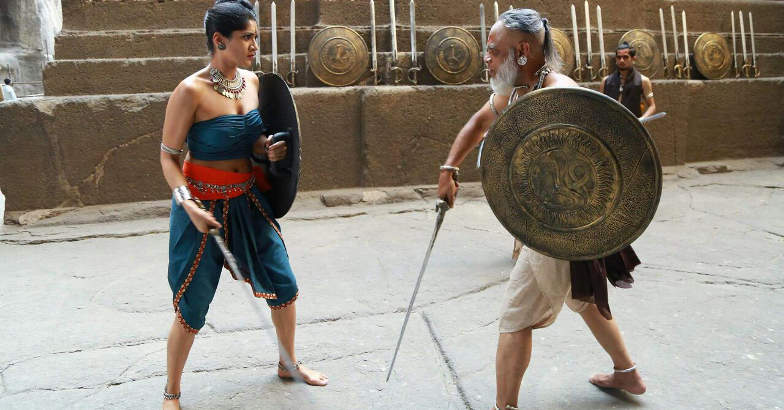
  2. Close weapon combat: Amukta. Weapons that cannot be released from the hand. Gadha (mace), KhadgaVidya (sword), Danda (stick)-Silambam, Gatka. 
  3. Range weapons: Mukta
    1. PaniMukta (weapons released by hand). Throwing (spear) & Archer (bow/arrow). 
    2. YantraMukta (weapons released by machines).
  4. MuktAMukta: released with mantras & the power of the mind. Ended with Dvapara Yuga. Kali Yuga humans lack the mental strength.

Arthashastra (salt-petre). All ingredients of gunpowder except Sulphur. Used in rocket warfare. Preserved by the Maharaja of Mysore. Damaged in Independent India.
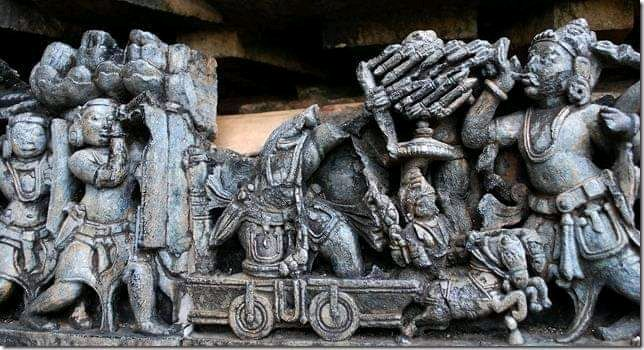
Halebidu temple carving


Crouching tiger/hidden dragon has a scene with a Gadha. https://youtu.be/Hp_KhU2h5XQ?t=114

Ramayana: Anjaneya never uses Gadha. Only Vali & Sugriva knew to use weapons, only PaniMukta like Gadha. Vanaras would fight by throwing rocks, trees & mountains.

Types of war

  1. Achara Yuddha: right type of warfare with rules followed.
  2. Rakshasa Yuddha: Enemy who follows no rules & harms civilians. Vasishta recommends not following Achara Yuddha & following Koota Yuddha instead.
  3. Koota Yuddha: Use strategy, tactics & deception without stooping to Rakshasa Yuddha.
  4. Dharma Yuddha: war to restore & preserve Dharma.

Learning

64 arts includes martial arts that everyone is expected to learn. 

Krav Maga

Invented by Imi Lichtenfeld. Designed for modern combat building & street fighting based on the knowledge of martial arts systems of the world. Special forces train. Do not get hurt during training.

Combat tournaments in the West

Earlier western martial arts tournaments avoided contact. Bruce Lee changed that. Initially preferred Kung Fu. Later, changed philosophy. Be formless, adapt like water.

Firearms

YantraMukta: recommended to learn. Safety precautions to be taken, as in Marma Kalai training. Women now have the ability to protect themselves against much stronger foes with minimal training.

Wednesday, March 01, 2023

A political agenda to fulfill a vaccuum in India

Currently, there's a vaccuum on certain issues that politicians are afraid or unwilling to handle. There is a political opportunity for whoever can seize it, by promising the following agenda. 

  1. Repeal RTE (Right to Education) Act that is forcing Hindu schools alone to conform to onerous regulations, resulting in their shutting down.
  2. End reservations.
  3. Repeal 498a.
  4. Amend Waqf board act to reduce its powers
  5. Regain church land. End Hindu tax payer funding to religious schools, which will hit the church & madarassas.
  6. Dissolve the minority commission.
  7. Repeal the SC/ST act.
  8. Allow terrorized victims to bear arms legally in the Red Corridor, Kashmir & Mizoram/Meghalaya.
  9. Free Hindu temples from govt control
  10. Dissolve Supreme Court collegium. Have the parliament nominate & ratify appointments similar to USA.
  11. Don't allow courts to postpone or stay cases unless there is severe sickness or death of the plaintiff, defendant or judge.
  12. Revoke communist labor laws. Make the entire country a SEZ (Special Economic Zone) instead of a pocket.
  13. Make freedom of speech absolute. Have a high bar for libel. Revoke 'hurting religious sentiments of people' laws.
  14. Legalize citizen spying for corruption. Share recovery with whistleblowers.
  15. Revoke places of worship act.
  16. Revoke licenses of NGOs & foreign media.
  17. Severe punishment for littering. Japan & Singapore implemented this severe punishment resulting in cleanliness.
Even winning some seats with this agenda can help.

Wednesday, February 15, 2023

India's biggest problems

Observations on the biggest problems of India in order of priority that the leadership is afraid of tackling.
  1. Waqf board land-grabbing & judicial extraordinary powers. Now 2nd largest landowner in India. Powers granted by PV Narasimha Rao & Jawaharlal Nehru governments. Tackling will lead to riots & push-back by the 2nd most powerful global power: Islam. 
  2. Church land grabbing. Originally leased by the colonial British. Now the largest landowner in India. Tackling will result in pushback by the most powerful global power: Christianity.
  3. Reservations. Mired Indian society in mediocrity, deepening fault lines & hatred against the native Hindu culture, traditions & religion. Pushed through by Ambedkar with a time limit of 25 years that is now indefinite & worsened by Vishwanath Pratap Singh. Tackling with result in riots & push-back by the two of the three most powerful global powers: Communism & Christianity.
  4. No-go areas, Intolerant demographic change, rioting & Ethnic cleansing: Needs heavy funding, powerful policing & an end to no-go areas. Restoration of rights & properties of Kashmiri Hindus & Bru Mizoram Hindus. Article 370 & 35A revoked but remaining Kashmiri Hindus still terrorized. Problems are the Red Corridor (Communism, Maoism, Naxalism), Kashmir (Radical Islam), Mizoram/Nagaland (Radical Christianity). 
  5. Minority commission: Special rights for global powers of Christianity & Islam. Setup by the Manmohan Singh/Sonia Gandhi govt. States where Hindus are a minority deny the minority status to Hindus to deny them govt aid. Idea comes from Communism which uses western models to presume that majority oppresses minority.
  6. SC/ST Act: Guilty under proven innocent draconian law passed by Vishwanath Pratap Singh. Order to dilute by the Supreme Court overturned by the government under threat of violence & loss of power. Tackling will be opposed by Communism.
  7. 498a: Passed by Indira Gandhi. Guilty until proven innocent law that devastates husbands & their extended families. Devastates the family structure. Tackling will be opposed by the feminism wing of Communism.
  8. RTE: Right to Education Act applicable only to Hindu schools with onerous regulations forcing them to shut down.
  9. Government control of Hindu temples: Communist, Evangelist & Islamic governments control only Hindu temples interfering with its function, tax & loot the temples impoverishing the temples. Setup by the colonial British.
  10. Collegium: Supreme Court Justices elect themselves. Setup by the colonial British only in India to ensure judges loyal to the British but not implemented in Britain.  Takes huge breaks, capricious & hears frivolous cases. Will be opposed by the Supreme Court losing its powers.
  11. Legal backlog: Hearings keep getting postponed or stayed. Can be solved by a simple rule used by a Pakistani judge. No postponements unless there is a severe sickness or death of plaintiff, defendant or judge.
  12. License-permit Raj & labor laws: Socialist communist system that is a nightmare for new businesses & closing businesses a bigger nightmare. Communist labor laws circumvented with SEZs (Special Economic Zones) & some legal convolutions fixed. But needs a lot more work.
  13. Bullying by foreign powers seeking break-up of the nation to control smaller states: Can be achieved by fixing internal problems & boosting the economy. 
  14. Colonial system: Genociders glorified, worshipped, have cities & roads in their name owing to colonial history. State looks to fix the natives instead of serving them. High courts & the Supreme Court require English to deliver justice. Higher education requires English. Imposed by the colonial British. Results in mental colonization & looking down on native cultural wisdom.
  15. Corruption: Worsened by a continuation of the British colonial systems. No easy solutions. Maybe temporarily weaken privacy laws, strengthen whistle-blower laws & enable citizen spying & journalism. Add incentives by sharing corruption recovery funds with the whistle-blowers.  
  16. Cleanliness: Can be fixed by punishment for littering as in Singapore & Japan, & less corrupt waste management. Waste management contracts are given to political contacts, spending a large amount of public money for the poorest service.
  17. Places of worship act: Passed by PV Narasimha Rao govt. Denies Hindus from reclaiming any of their demolished holy shrines. Goes against principles of natural justice. Law not enforced when demolishing Hindu shrines for 'development'.

What would be your list in order of priority?

Tuesday, February 14, 2023

Seeding Worlds: How Life Transformed Venus and Unveiled the Mysteries of Earth's Origins

In the early years of the 22nd century, humanity faced an unprecedented threat. The CO2 levels in the Earth's atmosphere had reached catastrophic levels, and scientists knew that if nothing was done, the planet would soon become uninhabitable. In a desperate move to save their home, they turned their attention to the neighboring planet of Venus, which was known for its extreme heat and thick clouds of CO2.


A team of scientists developed a plan to populate Venus with thermophiles and tardigrades, two resilient types of organisms that could survive in the planet's harsh conditions. They designed special capsules that could withstand the heat and pressure of Venus, and loaded them with the organisms before launching them towards the planet.


The capsules landed on Venus and released the organisms, which began to multiply and thrive in the hot, hostile environment. Over the years, as the organisms grew and adapted, they started to produce oxygen, gradually reducing the CO2 levels in the planet's atmosphere.


Meanwhile, on Earth, scientists had developed advanced carbon capture technology that could capture CO2 and store it safely. They discovered that the technology could be powered by heat energy, and began to tap into the geothermal resources of the planet to power their machines.


As the carbon capture technology improved, scientists realized that it could be used on Venus to accelerate the process of reducing CO2 levels. They designed special machines that could orbit the planet at low altitudes, using the heat of Venus to power themselves and capture carbon. The machines gradually reduced the CO2 levels on Venus and generated oxygen, which began to transform the planet's environment.


Over the centuries, the temperature on Venus began to drop, and the planet became increasingly habitable. Multiple carbon capture machines were seeded across Venus, capturing carbon rapidly and emitting oxygen. The Venusian CO2 clouds started clearing, and the temperature started reducing to earth levels over a few centuries.


Finally, humans were able to travel to Venus and explore its new, transformed environment. But they soon discovered that the higher radiation levels made it difficult to live on the planet without protective gear. Nonetheless, they marveled at the stunning beauty of the planet and the incredible progress that had been made.


Scientists on Venus began to study the organisms that had been seeded on the planet, and discovered that they had evolved into new, different forms. They continued their research, trying to understand the evolution of life on Venus, when one scientist made a stunning discovery.


Through his research, he found evidence that Earth had once been seeded with similar organisms, thermophiles and tardigrades, and that humans had eventually evolved from them. This revelation sparked a new era of scientific inquiry, as researchers around the world tried to unravel the mysteries of their own origins.


As humanity continued to explore and transform the universe around them, they were left with an open question - who had seeded Earth, and for what purpose? The answer remained a mystery, but it didn't stop humans from looking towards the future with hope and wonder.

Sunday, December 11, 2022

Indian support for France: a historical political overview

Sometimes, sports is influenced by politics & history. Some Indians cheered France over England in the football world cup.

Understandable since memories of British colonization & their impoverishment of India while starving the people to death are still fresh. However, the French East India company had also colonized parts of India.

In Puducherry (Pondicherry), the Vedapureeshwarar Shiva temple was desecrated with filth with filth also thrown on devotees & finally demolished by the French East India company. This was led by the Governor's wife, Madame Dupleix & the priest of Karaikal, Coeurdoux. The Immaculate Conception Cathedral was built on top. 

This is cautionary tale on blindly following woke feminism, which blindly argues for reservations for women, which countries like India have implemented reserving legislative seats for women. There are women like Ahilyabai & Chennamma on one hand who exhibit the highest feminine qualities, and women like Dupleix who exhibit the worst qualities. Later, Kandappa Mudaliar reconstructed the temple at a new location with public funds.

French colonization was brutal throughout the world. The Mission civilisatrice (civilizing mission) was intended to spread their language & religion, openly proclaiming a 'duty to civilize the inferior races'.

In any problematic relationship, things are good as long as the victim remains silent or praises the perpetrator. Openly discussing the problems would reveal the true nature. A good test of character would be asking for reparations & seeing the reaction. Maybe even something as simple as requesting a Vedapureeshwarar temple replica in France as atonement. Or even restoring Notre Dame as a place of worship to the excavated Vulcan & old religion deities to atone for their own historical persections. Will the virtue-signaling of Liberté, égalité, fraternité melt away quickly?

Monday, November 14, 2022

The unbaked pot

Gora Kumbhar, the potter had a few guests. The four siblings, Nivritti, Gnaneshwar, Sopan & the little sister Mukta Bai had arrived, along with Namadevar.

The little Mukta, the embodiment of Shakti, decides on a small Leela (play) & asks the old potter.

"How do you make pots?"

"Just as Panduranga makes everything & everyone as pots from the 5 elements of earth, water, fire, air & space, I make pots from just earth".

"How do you decide if the pot is correctly baked?"

"I hit it with a stick & listen to the sound".

"Can you also hit us, the pots of Panduranga, with this stick & see if we're baked or unbaked? Please Mama (uncle), Please. My brothers first."

Gora Kumbhar gently taps a smiling Nivritti, Gnaneshwar & Sopan.

"Please tap me, please..."

Gora Kumbhar gently taps a giggling Mukta. Namadevar is just sitting aloof.

"Mama, please tap Namadevar Mama as well."

Gora Kumbhar hesitates. Namadevar doesn't seem too approving.

"Oh please, tap him as well."

Gora Kumbar taps Namadevar, who explodes in rage. "What kind of a stupid game is this?"

Now, Mukta says: "Oh, so this is the unbaked pot!"

With a face blackened with anger & humiliation, Namadevar storms out, ignoring Gora Kumbhar's apologies & explanation that he was only humoring a child.

He repeatedly complains to Panduranga. "Me, your Bhakta, who is constantly singing your names & your glory, how could I be subject to such humiliation?" When normally he would get a response, he gets only a surprising silence. Dejected, when he goes to take his life, finally he gets a response. "It is you who has humiliated my Bhakta, Gora Kumbhar by storming out when ignoring him. And Mukta is right; you are an unbaked pot. Find yourself a Guru & get yourself ready."

And Namadevar goes in search of a Guru. (Read that story here.)

Monday, October 10, 2022

Ponniyin Selvan I - historical musings

The movie keeps referring to Sri Lanka as Lanka (Ilangai). This name is fairly recent. The right name should have been SwarnaDvipa, Tamraparni or Simhala. Simhala was populated by people from Kalinga (now Odisha). Sinhala is Samskritam based & still has similarities to Odisha. https://bharatbhumika.blogspot.com/2015/11/geography-of-ramayana.html

The movie accurately refers to Ashoka's daughter respectfully in Simhala. After Ashoka converted to Buddhism, his children become missionaries. Sanghamitra does go to Simhala & the people convert to Buddhism under her influence. However, the Mauryan empire collapses after Ashoka.

In war scenes, the warriors are not wearing war helmets that protect the nose. In a beach battle, ArulMozhi is wearing a turban. In the middle of a battle, he removes his turban. I understand that actors are paid for their expressions & the need to show them to the audience. A better way would be to show the war helmet getting knocked off in battle. Gowarkar does this well in Panipat. 

Also, in the beach battle, the Chozha army is shown coming ashore while the Sinhala army is waiting. Either the ships need projectile weapons to provide covering fire to the boats coming ashore, or the soldiers need to come ashore in stealth. Else, the beach landing will fail. This battle could have been better thought through. Also, an unarmed ArulMozhi swimming to the enemy ship while they were watching would be easily captured. It was unrealistic to show him climb unarmed & then defeating multiple warriors.

Sundara Chozhan is shown as being treated with acupuncture by Chinese physicians. Varma Kalai, a part of Hindu martial arts like Kalari Payattu, used acupressure. This was introduced to the Shaolin temple by Buddhabhadra who founded it in 496 CE, the 1st abbot & later by Bodhidarma, the 2nd abbot. The acupressure martial arts techniques were later developed into acupuncture by the Chinese. But this would have taken multiple centuries. It seems incongruous to show this treatment in the movie. The director could have shown acupressure or some kind of oral medicine. https://www.facebook.com/trueindology.org/posts/this-painting-from-ancient-shaolin-temple-china-depicts-the-indian-monk-buddhabh/1134417563425428/


Friday, October 07, 2022

Ponniyin Selvan I - movie review

If you are willing to overlook the now normalized anti-Brahmin Hinduphobic subliminal messaging in Tamizh movies, the movie is a decent adaption of the writing. Kalki's plot is imaginative, intricate & sprawling, with multiple characters, with adventure, thrills, subterfuge, mystery, action, drama & romance. It has all the NavaRasas. Owing to its scale, people tried & failed to make a movie out of it, since releasing a movie as multiple parts wasn't an idea back then. The story is better suited as a TV series. As a movie, the narrative is linear & some characters were either removed or relegated to small roles.

The make-up artists did a great job. The relatively old Aishwarya & Trisha still look good. The art is good. The music is decent with decent songs & good back-ground music. The lyricist who wrote the Murugan song wonderfully using the Tamizh name of Seyyon while using Thiruppugazh like lyrics. Arunagirinathar pioneered using words with specific sounds to indicate the end of phrases or a beat in the Thiruppugazh which was used here. It was lovely to hear the old Tamizh. The actors did a good job. It was nice to hear Vedic chants & Vetrivel.

Now, to the bad.

In the book, Azhwarkadiyan Nambi is an intelligent spy sent by ArulMozhi Verman. The banter between Nambi & VanthiyaDevan is sharp but respectful & good-natured. But Tamizh cinema & literature has been caricaturing Brahmins for decades now. When was the last time you saw a positive Brahmin character in a Tamizh movie? The movie converts Nambi into a buffoon. He is called derogatory names, repeatedly assaulted & water-boarded by VanthiyaDevan in an attempt at humor. His sacred thread is cut & he complains like a buffoon. In the light of Dravidar Kazhagam folks boasting on video on physical attacks on Brahmins with quotas on cutting their sacred thread and repeated physical attack recorded, this continues normalizing brutalizing Brahmins as subliminal messaging. He could simply have stuck to the story & character as represented by the author.

Madurantakan, the Shivan Adiyar, says that he will no longer follow Shiva & rips off all his Rudraksham Malai. Why this explicitly Hinduphobic scene deviating from the book?

Devars are Maha-Muruga Bhaktas. They will have the Vibhuthi Thiruneer & Kungumam always. Not having it means that someone has passed away in the family. They also had a unique hair style in those days. Vanthiya Devan has a bare forehead & the current day Western hair cut.

ArulMozhi Verman, who called himself Siva Pada Sekaran does not have the Thiruneer Vibhuthi is all scenes. He is also not wearing the sacred thread.

The dialog delivery of Vikram & Aishwarya's dubbing artist in SenTamizh was wonderful. All others struggled. The previous generation actors were fluent in SenTamizh. In just one generation, that skill seems to have gone. Many English educated Tamizh people can no longer even read Tamizh, let alone write it. Independent India has been a disaster in increasing mental English colonization & subjugating its native languages. Some Indic languages have already gone extinct. It is only going to get worse from here.

In an early trailer, it said: Ponniyin Selvam rather than Selvan before it was pulled. Lack of attention to detail.

The lead actors cast were too old for the actual characters in the story. ArulMozhi Verman was a mere 19 year old boy in the story. The casting could have been better. This could have launched some young careers.

From people who haven't read the book, I heard that the pace is quick & hard to follow. You need a background to understand the movie. But then, the mystery of certain acts would be lost.

The song on Murugan had interesting art & costumes. But it depicted the Chozhas, the patrons of high culture, somewhat semi-barbaric.

The actress playing Vanati is highly flexible & a good dancer. But wasn't good looking enough to play the future Rani (queen).

I wish that Tamizh cinema had directors with the skill of KS Gopalakrishnan who could make Dharmic movies. ManiRatnam is a decent director who has done a decent job but has chosen to de-Hinduize & add anti-Brahmin elements to the film to the extent possible. VetriMaran & KamalHassan, both excellent in the film profession, have chosen to publicly display their ignorance of history, showing how deep the Marxist-Missionary propaganda has been internalized. This is a reminder that excellence in one field does not mean knowledge in another.

In Marxist strategy, it is important to capture education through academia, entertainment & media. Once captured, in just two generations, per Marxist theory, the commoners can be taught to hate their ancient culture & follow Marxism. ManiRatnam's son, Nandan, was a star at a Communist party meet where he publicly admired Marxism & wrote a paper on Leninism. He now studies theology in Christ college. A classic Marxist-Missionary product. The apple doesn't fall far from the tree.

Wednesday, September 21, 2022

From the Purusharthas to Financial Security-Talk outline

Part I:
  • Disclaimer
  • FIRE, Fat FIRE (better lifestyle), Lean FIRE (Frugal), Coast FIRE (continue working), Barista FIRE (low-stress low-income job)
  • Basic Security
    • No High-interest debt
    • 1 year emergency fund
  • Lend
    • How Banks make money
    • Lock-up money
      • Savings/Money Market
      • CD laddering
      • Brokered CDs
    •  Bonds
      • I-Bonds
      • Bonds vs Bond mutual funds
        • Expenses & load
        • Govt vs Corporate, duration, tax-free (CA municipal vs US govt), US vs international vs emerging, hedged vs unhedged.
    • P2P: Prosper. (LendingClub shut down).
    • Real-Estate hard loans for accredited investors. Flippers open new biz for every flip, OPM.
  • Invest
    • Stock
    • Long vs Short
    • Derivatives
    • Hedging
    • Mutual Funds: Open vs Closed, Active vs Passive Index, Stock vs Bond vs Balanced, US vs International vs Emerging Markets vs World
    • Diversify: Total World Stock, Target Retirement Funds. Investment theory: stocks over long term. Exceptions like Japan.
  • Employee Plans
    • ESPP
    • ESOP in a startup: 83b early exercise option
    • RSUs
    • 401k, Roth 401k: early withdrawal penalty
    • Rollover IRA: Direct rollover & indirect rollover
  • Defer taxes
    • IRA, Roth IRA, 10% penalty
    • 529
  • Credit card rewards
    • Cash back: flat-rate vs rotating rewards
    • Points
    • Benefits like trip insurance, rental car
    • Paid vs free (primary rental car insurance)
    • Extended Warranty
  • Business
    • Expenses after tax vs biz expenses before tax
  • Will vs Trusts (Probate doesn't include liabilities, but increases administration work)
  • Annuities
  • Life Insurance
    • Returns (eg: term life, permanent life[whole, variable universal, universal])


Part II:
  • Is it ok to make money?
  • Asceticism vs money/power/fame/social status.
  • Purusharthas
  • Artha
  • Artha Shastra
    • Vidura Neeti: 5 strengths
      • Physical
      • Good advice
      • wealth
      • family, lineage & social capital
      • intellect
    • Saraswati, Lakshmi, Shakti worship
  • Asceticism
    • Drithirashtra's envoy to Yudhishtira & Yudhishtira's response
    • Types of asceticism
      • Uncha Vriddi: Thyagarajar
      • Staying home: Muthuswami Dikshitar
      • Pattinathar & Pathragiriyar
  • Charity
    • Daily practice: Some food. Tirumoolar's Tirumanthram.
    • Trigunas
      • Nine types: Padma Purana
    • Charity to the undeserving.
    • Deham vs money.

Wednesday, August 24, 2022

Bhajanai (Bhajan) beginning-Haridas Giri

प्रह्लादनारदपराशरपुण्डरीकव्यासाम्बरीषशुकशौनक भीष्मदाल्भ्यान्।

रुक्माङ्गदार्जुनवशिष्ठविभीषणादीन् पुण्यानिमान् परमभागवतान् नमामि॥

prahlāda nārada parāśara pundarīka,
vyāsa ambarīsha śuka śaunaka bhīṣmadālbhyān
rukmāngada arjuna vasiṣṭha vibheeshanadi
puṇyānimān parama bhāgavatān smarāmi

Thursday, August 18, 2022

Katha Upanishad – Part 2 – Canto 1 – Verse 14: Katha-2-1-14-yathodakaṃ

Rain water that falls in craggy places loses itself, dispersed throughout the mountains.

One who pursues the truth (without focus) in different places has the effort dispersed & fruitless.

यथोदकं दुर्गे वृष्टं पर्वतेषु विधावति ।

एवं धर्मान् पृथक् पश्यंस्तानेवानुविधावति ॥ १४॥

yathodakaṃ durge vṛṣṭaṃ parvateṣu vidhāvati .

evaṃ dharmān pṛthak paśyaṃstānevānuvidhāvati .. 14..


Tuesday, August 16, 2022

Rig Veda 8.48.3 - Soma, immortality & enmity

We have drunk the Soma. We are immortal. We have attained the light & known the Gods.

What can the hatred & malice of a mere mortal do to us now?

अपा॑म॒ सोम॑म॒मृता॑ अभू॒माग॑न्म॒ ज्योति॒रवि॑दाम दे॒वान् । किं नू॒नम॒स्मान्कृ॑णव॒दरा॑ति॒: किमु॑ धू॒र्तिर॑मृत॒ मर्त्य॑स्य ॥

apāma somam amṛtā abhūmāganma jyotir avidāma devān | kiṃ nūnam asmān kṛṇavad arātiḥ kim u dhūrtir amṛta martyasya ||

Saturday, August 13, 2022

Truth, untruth & our own mind

Truth, when questioned & debated on, will emerge with more clarity.

Untruth, when questioned, can lead to anger & violence.

How about our own views? When questioned or mocked, how does it react? For most of us, it can react with anger. For some, the angry mind can direct the body towards physical violence.

Why does the mind react that way? Does it know at some deep level that its opinion is not the truth?

Only by observing our own mind's antics can we even start to unravel the truth.

Questioning truth & untruth

Truth will survive questioning & debates. Truth does not need human belief to exist. 

Untruth will react harshly to questioning since the conclusion will wipe it out. As a survival instinct, it can come up with sophisticated societal mechanisms to prevent its questioning. It can lead to loss of life, physical pain, loss of freedom or career. Sometimes, organized society like the government will enforce the punishment through laws & judiciary. Other times, unorganized society will enforce the punishment through extra-judicial means through unexpected physical attacks to cheers by its supporters.

Any society & culture in history can be rated on how well they allowed free open debates and what happened to people with dissenting opinions.

How would you rank your current society?

Saturday, July 30, 2022

Your actions, your friend & enemy - Bhagavad Gita

Your own actions raise or lower you. You are your own friend & enemy. - Krishna

उद्धरेदात्मनात्मानं नात्मानमवसादयेत् ।

आत्मैव ह्यात्मनो बन्धुरात्मैव रिपुरात्मनः ॥ ६-५॥


Sunday, June 26, 2022

Did Drona refuse to teach Karna?

There is a common myth that Drona refused to teach Karna. Per the Mahabharata, Karna was Drona's sishya. He says so himself & also by Narada. Drona refused to teach him the Brahmastra for which he went in disguise to Parasurama.

Evam duryodhanaha karnaha sakunischapi saubalaha
Aneki rabhyupayisthan jighamsanthi sma pandavan
This was during their childhood before formally starting their education with kripacharya. Karna and Sakuni used to help duryodhana in his attempts to kill pandavas (poisoning, etc)

Vrishnayaschandhakaschiva nanadesyascha pardhivaha
Sutaputrascha radheyaha gurum dronamiyat tada
Spardhamanasthu pardhena sutaputro athyamarshanaha
Duryodhanam samasritya soavamanyata pandavan
This was during their education from Dronacharya. Many came over to Drona for training, including Vrishni and Andhaka clans (Yadavas) and others. Karna also came. He used to get into conflict with Arjuna always, was impatient, got support from duryodhana. Together they used to insult pandavas

Tatoabhijagmuhu panchalan nighnamtaste narashbhaha
Mamrudustasya nagaram drupadasya mahaujasaha
Duryodhanascha karnascha yuyutsuscha mahabalaha
Dussasano vikarnascha jalasandhaha sulochanaha
This was when kauravas and all others, including karna, first attacked drupada to give guru dakshina to drona

Vyadhamat tanyaneekani tatkshanadeva bharata
Duryodhanam vikarnamcha karnam chapi mahabalam
Karna durdhanauchobhau sarihi sarvangasandhishu
Ashtavimsatihi sarvihi prudhak prudhagarjndamaha
This was during their war with drupada, who beat them, including very strong Karna

Tavapi viditam deva mamapyastrabalam mahat
Jamadagynyadupattam yat tadha dronanmahatmanaha
This is towards the end of pandavas exile. Here Karna's story is described in detail. 
Surya deva attempts to warn karna, that indra would seek his natural kavacha and kundalas. Karna here is replying that he has acquired great strength of astras from parasurama and drona

Tatropasadanam chakre dronasyeshvastrakarmani
Sakhyam duryidhanenivam agamat sa cha viryavan
Dronat kripachcha ramachcha so astra gramam chaturvidham
Labdhva loke abhavat khyataha parameshvasatam hahaha
Karna became a student of drona in childhood and befriended duryodhana there itself.
Karna received four kinds of astra vidya from drona, kripa and parasurama as well and thus got reputation as being one of the foremost.

Research: a friend

--------------

1)Mention in Adi parva of Karna being Drona’s student

Excerpt from: https://www.sacred-texts.com/hin/m01/m01135.htm

“O bull of the Bharata race, many other princes also flocked to that best of Brahmanas for instruction in arms. The Vrishnis and the Andhakas, and princes from various lands, and the (adopted) son of Radha of the Suta caste, (Karna), all became pupils of Drona. But of them all, the Suta child Karna, from jealousy, frequently defied Arjuna, and supported by Duryodhana, used to disregard the Pandavas.”

2) Mention of Karn being Drona’s student in Santi Parva by Narada

Excerpt from: https://www.sacred-texts.com/hin/m12/m12a002.htm

“For this, a child was conceived by Kunti in her maidenhood, capable of provoking a general war. Endued with great energy, that child came to have the status of a Suta. He subsequently acquired the science of weapons from the preceptor (Drona), that foremost descendant of Angirasa's race.”

3) Karna in gurudakshina war with Drupad: Adi Parva: Sambhava parva: SECTION CXL

Excerpt from: https://www.sacred-texts.com/hin/m01/m01141.htm

“Those bulls among men, smiting the Panchalas on their way, laid siege to the capital of the great Drupada. And Duryodhana and Karna and the mighty Yuyutsu, and Duhsasana and Vikarna and Jalasandha and Sulochana,--these and many other foremost of Kshatriya princes of great prowess, vied with one another in becoming the foremost in the attack. And the princes, riding in first class chariots and following the cavalry, entered the hostile capital, and proceeded along the streets.”
“And careering over the field of battle like a fiery wheel, king Drupada with his arrows smote Duryodhana and Vikarna and even the mighty Karna and many other heroic princes and numberless warriors, and slaked their thirst for battle.”

4) By inference, we can make out Karna was Drona and Kripa's student because out of all those assembled at Rangbhoomi (where the princes are displaying their skills) he bows only to these two. Later he takes Drona's permission too, showing that he is his guru:

Excerpt from: Adi Parva: Sambhava Parva: Section CXXXVIII

“The mighty-armed warrior, eyeing all around the arena, bowed indifferently to Drona and Kripa. And the entire assembly, motionless and with steadfast gaze, thought, 'Who is he?' And they became agitated in their curiosity to know the warrior.”

“Then with the permission of Drona, the mighty Karna, delighting in battle, there did all that Partha had done before. And, O Bharata, Duryodhana with his brothers thereupon embraced Karna in joy and then addressed him saying, 'Welcome O mighty-armed warrior!”

5) In Karna’s own words to Surya, he was Drona’s disciple.

Excerpt from: Vana parva: Pativrata mahatmya parva: https://www.sacred-texts.com/hin/m03/m03300.htm

“Karna said, 'As thou, O lord of splendour, knowest me for thy worshipper……………..Thou knowest, O deity, that I have great strength of weapons obtained from Jamadagnya and the high-souled Drona.”

6) Another mention from Vana parva: Pativrata mahatmya parva:

Excerpt from: Vana Parva: Pativrata-mahatmya Parva: Section CCCVII

“And after Karna's adoption, Adhiratha had other sons begotten by himself. And seeing the child furnished with bright mail and golden ear-rings, the twice-born ones named him Vasusena. And thus did that child endued with great splendour and immeasurable prowess became the son of the charioteer, and came to be known as Vasusena and Vrisha. And Pritha learnt through spies that her own son clad in celestial mail was growing up amongst the Angas as the eldest son of a charioteer (Adhiratha). And seeing that in process of time his son had grown up, Adhiratha sent him to the city named after the elephant. And there Karna put up with Drona, for the purpose of learning arms. And that powerful youth contracted a friendship with Duryodhana. And having acquired all the four kinds of weapons from Drona, Kripa, and Rama, he became famous in the world as a mighty bowman. And after having contracted a friendship with Dhritarashtra's son, he became intent on injuring the sons of Pritha”

Drona taught warriors from all over, not just Kurus. Even Krishna’s clansmen were Drona’s pupils.

------------

He saw that Dhananjaya was superior to everyone in learning about dhanurveda. Karna secretly went to Drona and spoke these words. ‘I wish to know about brahmastra and the secrets of releasing and withdrawing it. It is my view that I should become Arjuna’s equal in battle. It is certain that the affection you bear towards your disciples is equal to what you bear towards your son. Because of your favours, make me accomplished and skilled in the use of weapons.’ Drona was partial towards Phalguna. He also knew about Karna’s wickedness. Having been thus addressed by Karna, he replied, ‘The brahmastra can only be known by a brahmana who is observant of the vows, or by a kshatriya who has performed austerities, and by no one else.’ Having been thus addressed by the best of the Angirasa lineage, he honoured him and took his leave. He then quickly went to Rama11 on Mount Mahendra.
Source: Bori ce chapter-1330(2)
~Shanti Parva, Dr. Bibek Debroy’s translation

--------------------
BORI CE Volume - 1 
SECTION SEVEN: (Sambhava Parva):
"Then the valorous Drona taught Pandu's sons the use of many weapons, human and divine. O bull among the Bharata lineage! Other princes also came to Drona, supreme among Brahmanas, to learn the use of arms - the Vrishinis, the Andhakas, kings from many countries and Radheya (Karna), the son of the suta. They made Drona their preceptor.

BORI CE Volume - 3
SECTION FORTY-THREE (Kundala-Aharana Parva):
"O god! O one who spreads light! In so far as the words about Pandava Phalguna are concerned, remove all torment and misery from your mind. Concerning Arjuna and me, I will vanquish Arjuna in battle. O god! You know about the great strength of weapons I have obtained from Jamadagni's son and from the great-souled Drona.

------------
सूतपुत्रश्च राधेयो गुरुं द्रोणमियात्तदा |
स्पर्धमानस्तु पार्थेन सूतपुत्रोऽत्यमर्षणः ||४७||
दुर्योधनमुपाश्रित्य पाण्डवानत्यमन्यत ||४७||
Radheya the son of the suta, also made Drona their preceptor. The suta’s son was envious of Partha and always competed with him. With Duryodhana’s support, he showed his contempt for the Pandavas.


References:

The animal, the master & the bond

Shaiva Siddhantham (शैव सिद्धान्तः, சைவ சித்தாந்தம்) has a concept of Pashu (पशु, பசு) Pathi (पति, பதி) Pasham (पाश , பாசம்).

Pashu

Pashu is the name for a cow or cattle or just an animal. It also means the normal innocent folks (us) who go about their daily work.

Pathi

Pathi means master. In this case, Pathi is the master of the Pashu. The famous Yogic pose seal with surrounding animals from the Mohenjodaro excavation site is called the Pashupati (master of animals) seal. Pashupati is also a name for Shiva.

Pasham

Pasham refers to a bond. This can be a physical bond, like a rope, called a Pasha Kayiru. This can also be a bond of affection, which is the meaning in Tamizh.

Jnanam

Next comes of concept of Jnanam (knowledge) which is classified as Pashu Jnanam, Pasha Jnanam & Pathi Jnanam.

Pashu Jnanam

Normally, an animal is considered innocent & without knowledge. We sometimes feel pity for it. It just leads its life without any higher pursuits. When we see a human in distress, we feel pity for that human. A lack of luck & knowledge in navigating the complex human system leads to distress. Extending this further, is there any of us who does not have difficulties? Is any of us truly happy in our search for permanent happiness? Maybe we are all to be pitied? When the Pashu thinks that maybe there is something more that our daily activities, something beyond that needs to be sought, this is Pashu Jnanam.

Pasha Jnanam

Next is Pasha Jnanam. We have attachments to our family, friends, property, profession, school, college, gender, race, religion. How will take an insult to one of these? Our reaction determines our level of attachment. Maybe there is a different kind of attachment that we have that we are not normally aware of? Maybe an attachment to something beyond? Maybe everything is connected & attached? 

Most Vigrahas will have a Pasha Kayiru, a rope indicating the bond and also a sharp & blunt weapon that can break the bond. The one that will break the temporary material attachments & pull us towards the permanent attachment.

Thiruvalluvar in his Thirukkural says:

பற்றுக பற்றற்றான் பற்றினை அப்பற்றைப்

பற்றுக பற்று விடற்கு.

This means: desire the divine that has no desires & is beyond desire, to remove your (temporary) desires. Note that Thiruvalluvar did not add his name as a credit to the Thirukkural. The earliest reference to the authorship is from a Saivite text called திருவள்ளுவ மாலை which has other authors praising Thiruvalluvar for his Thirukkural.

Thie also mirrors an Upanishad analogy: desire like a lamp that burns itself out by focusing inside, rather than desire something external that will never permanently satisfy, like ghee in a fire.

When the Pashu starts investigating if there is a bond beyond, that is Pasha Jnanam.

Pathi Jnanam

Let us say that a cow is tied by a rope by a master. The cow can wander wherever it wants but cannot go beyond the rope. Maybe free will exists but is limited in scope. 

Maybe for all of us, there is such a bond. Instead of something with human emotions, maybe it is something beyond all emotions, beyond all comprehension, all pervading. Maybe we don't even need to seek it outside, being all pervading, it is within us.

When the Pashu finally knows the true nature of the Pathi, it knows the true nature of itself. It need not seek anymore. This is Pathi Jnanam.

References

Sudha Seshayyan's Upanyasam on Thiruvacagam

Saturday, June 25, 2022

Do we have free will?

Do we have free will? Religions try to answer this question.

If the omniscient divine has already known & planned everything, we are just executing it, thinking we are doing it. So, there is no real free will. Everything is just divine will.

If we do have free will, then we can make changes. Maybe the divine doesn't have a plan after all.

Some religions think that free will is a test from G-d. If we use our free will to surrender to the one true G-d, G-d will be happy & give us a chance at heaven. If not, he will roast us forever in an everlasting fiery hell.

Swami Vivekanda explained the Hindu concept as limited free will. Everyone is a Pashu (cattle) who is bound by a rope. We can wander as far and wide as the rope allows us, but not beyond. Shaiva Siddhantha expounds on this Pashu (cattle or us), Pathi (master) & Pasham (the thing that ties).