Thursday, March 12, 2026

Death & rebirth

Shows:

First episode of Netflix's Surviving death: NDE

Penultimate episode of Netflix's Surviving death: Premonitions

Last episode of Netflix's Surviving death: Rebirth. 3 cases in detail, 1 case in short.


Ian Stevenson's research from University of Virginia:

https://pearl-hifi.com/11_Spirited_Growth/01_Books/01_PLR_Lit/Stevenson_2016_Children_Who_Remember_Previous_Lives__A_Question_of_Reincarnation_496pgs..pdf

https://archive.org/details/casesofreincarna02stev

https://www.scribd.com/document/181161436/Dr-Ian-Stevensons-research-on-reincarnation-pdf

https://med.virginia.edu/perceptual-studies/wp-content/uploads/sites/360/2016/12/REI36Tucker-1.pdf


Cases:

Shanti Devi, born in Delhi, remembered her previous life in Mathura

Luke Ruehlman, white boy, remembers his past life as a black woman, Pamela Robinson, who died in a fire. Case covered in TV show: "The Ghost inside my child"

Cameron Macauly remembering vivid details of his house in his previous birth. In TV show "Extraordinary people" episode: "The Boy who lived before"

Christian Haupt, remembering prior life as a baseball player, Henry Louis Gehrig


National Geographic documentary: Moment of Death: Last episode: NDE


How to change your mind: Book & Documentary on psychedelics


Monday, February 23, 2026

Temples for blessings for couples to have kids

Mannargudi Rajagopalaswamy Temple (Tamil Nadu)

Known as Dakshina Dwaraka. Krishna in the form of a child & a cowherder.


Tripunithura Poornathrayeesa Temple (Kerala)
Santhanagopalan (means bestower of children).

Guruvayur Sri Krishna Temple (Kerala)

Guruvayurappan (Baby Krishna). Crowded nowadays.


Thrisshur Vadakkunathan Temple (Kerala)
Temple where Shivaguru & Aryambal prayed, and got Adi Sankara.


Thirukarukavur Garbarakshambigai Temple (Tamil Nadu)
Garbarakshambigai (Parvati as protector of the womb). Popular for pregnant women. Can be visited for blessings prior to pregnancy as well.

Sunday, August 25, 2024

PrAnAyAma overview

Yama is control. PrAnaYama is control of Prana, of which one aspect is breath. The goal is mental & physical health, preparing oneself, meaning the mind & the body, for higher pursuits in Yoga. Each of these PrAnAyAmas have different effects on the mind & the body. The breath is connected to the mind. During times of anger or passion, the breath becomes quick, raspy & uneven. During times of deep concentration, it can be deep. The concept here is that it is a two-way connection. By controlling the breath, the mind can be controlled. Such as asking pregnant women to consciously take deep breaths during delivery.


UjjAyi PrAnAyAma: Head down, Eyes closed, JnAna mudra. Slow deep steady breath, hold, slow deep exhale, hold.

Bhamari PrAnAyAma: Bhamari is a large black bee. Similar to Ujjayi, but during exhale, make a sound like a bee.

Surya Bhedana PrAnAyAma: Head slowly down, left hand Jnana mudra, eyes closed, Inhale slowly in right nostril, hold, exhale slowly in left nostril. For advanced practitioners who are able to do this in in equal intervals, hold after exhale.

NAdi Shodana PrAnAyAma: Similar to Surya Bhedana, but alternate nostrils. Typically, for all of us, one nostril will be more active than another when breathing, that can keep changing. The eventual goal is to have even breathing across nostrils over time.


BhastrikA PrAnAyAma: BhastrikA is a blacksmith's bellows used in a furance. Quick forceful inhale & exhale 12 times for 1 session. Stage 1 is both nostrils. Stage 2 is similar to Surya Bhedana, with quick forceful inhale on the left nostril & quick forceful exhale on the right nostril. 


KapAlaBhAti PrAnAyAma: A less strenuous version of BhastrikA. Slow inhalation with quick exhalation & small retention.


Sitali PrAnAyAma: Sitali means cool. Inhale with curled tongue through mouth with ssssa sound. Hold. Exhale with humming sound.

Sitakari PrAnAyAma: Variation of Sitali, cold PrAnAyAma. Inhale through mouth with straight tongue near teeth & slighted parted lips. Hold. Exhale with humming sound.


Sama Vritti PrAnAyAma: Uniformity in inhale, hold, exhale, hold. The hold after exhale is harder & can be gradually practiced. Can be practiced with most PrAnAyAmas.


Vishama Vritti PrAnAyAma: Irregular in inhale, hold, exhale. Ratios are 1:4:2, 2:4:1, 4:2:1 to begin with. The hold after exhale will lead to more ratios.


Viloma PrAnAyAma: Against the hair or grain, against the natural order. Pause or interrupt during inhalation or exhalation for a few seconds

Anuloma PrAnAyAma: Along the hair or grain, in natural order. Inhale through both nostrils, exhale through one nostril alternately.

Pratiloma PrAnAyAma: Prati means reverse or opposite. Inhale through alternate nostrils, exhale through both nostrils.


Sahita Kumbhaka PrAnAyAmas: Sahita means help. When breath is held after inhale or exhale to aid in PrAnAyAma. 

Kevala Kumbhaka PrAnAyAma: Kevala means only. When holding breath after inhale or exhale becomes part of our natural breathing, after practice.


Per the teachings, the number of breaths determine one's lifespan. For instance, dogs that breathe quickly up to 35 breaths per minute have a relatively shorter lifespan than a tortoise that has only 4 breaths per minute, that live much longer than humans. Correct use of PrAnAyAma can increase longevity.

Patanjali says in his Yoga Sutras: Just like the wind drives away smoke & impurities & allows a fire to burn well, PrAnAyAma drives away the internal impurities allowing the divine fire within to burn bright, preparing oneself for DhArana (external concentration) or DhyAna (focus within or meditation).  

However, there is a word of caution by SvAtmArAmA in Hatha Yoga PradipikA. "Prana should be tamed more gradually & slowly than lions, tigers or wild elephants, else it is dangerous". Please practice with caution.


Dhanyavadhaha, Thank you.


Talk on Yoga-5 minutes-Aug 2024

Namaste,

Today, we'll have a small demonstration on some aspects of Yoga.

What is Yoga?

Yoga is the fourth popular theistic philosophy of Hinduism, the others being NyAya, Vaiseshika, SAmkya, MimAmsa & VedAnta, and the atheistic ChArvaka.

Per its original philosophy, the world consists of all that is material called Prakriti, and that which is not material, called Purusha, which an be considered divine. When all that is material is removed, all that remains is the divine.

Yoga is defined in the second verse of the Yoga Sutras by Patanjali: Yogash Chittha Vriddhi Nirodha. Yoga defines the techniques to remove all that is material, including our own mind which is material in nature. It broadly comprises of 8 limbs, called Ashta Anga or AshtAnga.

The lower 4 limbs are:

Yama, meaning control, a list of Don'ts.

Niyama, meaning rules, a list of Do-s.

Asana, meaning posture, which is what the contemporary Western society recognizes as Yoga, which is being demonstrated now.

PrAnAyAma, meaning control of PrAna, of which one aspect is breath, which will demonstrated shortly afterwards.


This will prepare one for the higher 4 limbs, which are:

PratyahAra: withdrawal of senses

DhArana: focusing on something external

DhAna: focusing internally starting with our own mind

SamAdhi: the state of experience when that which is material is fully removed


The Asanas being demonstrated are good way to get started with this ancient philosophy to help us be fit & flexible with toned muscles.


Dhanyavadhaha & Thank you

Sunday, August 18, 2024

Avani Avittam 2024

Pratha Sandhyavandhanam

Samita Daanam for Brahmachari


In general, Pavithram should be removed during Achamaniyam & put back after.


Put Shubha Pavithram in ring finger with 2 darbai between ring finger, 2 below seat.

Kamo Karshyam japam. 1008 or 108.

Remove Pavithram, put on right ear. Discard Darbai north.


Madhyanigam.

Brahma Yagnyam.


Put Pavithram again. Take fresh Darbai for ring finger & below seat.

Maha Sankalpam.

Discard Darbai north. Put Pavithram on ear.


Put Pavithram after Achamaniyam.

Yagnopaveetha Dharanam with change of Poonal.


Take some Ellu (sesame) & Akshathai (rice with turmeric). Put in Pancha Pathiram.

Kaanda Rishi Tarpanam.

Remove Pavithram, put in ear.


Put Pavithram after Achamaniyam.

Veda Adhyena Arambam (also called Vedarambam).

Remove Pavithram. Unravel.

Do Achamaniyam. 

Complete.


References:

https://youtu.be/V0OlRk9FI3Q?si=7IrrgdUdhp4w6_WR


Friday, April 26, 2024

The tradition of ancestral worship

Many ancient cultures have the tradition of ancestral worship. Some Sanatana Dharma Sampradayas (traditions) and beliefs are explained here. In some Sampradayas, Pitru Vazhipadu (ancestral worship) is more important than even Daiva vazhipadu (divine worship). 

Once the body dies, what happens to the imperishable Atma (soul)? It can go to a better or worse place, or be reborn in the same place (earth) in a better birth (a good family) or a worse birth (a bad family or a non-human birth), or remain in deep sleep (MahaNidhra) awaiting a body, or in the worst case scenario, remain conscious without a body. The worst case scenario can occur, say during suicides, resulting in the worst suffering. 

When some saints pass, they will have a trickle of blood on the top of the head, indicating the exit to the highest place. Some may pass peacefully with the eyes looking upwards towards the center of the forehead, or with an open gaping mouth. These are higher places. A peaceful passing is an indication of passing to a higher place. 

Some may pass with the body in excreta. This is an indication of passing to a lower place.

After passing, the top of the body's skull is slightly manually cracked during the cremation process, in India, to allow the Atma to pass to the highest abode if possible. In a lack of religious freedom, this religious practice is banned in multiple Abrahamic countries that believe in bodies or ashes being raised up from the dead, & consider this 'body mutilation'. In contrast, Hindus cremate the body & mix the ashes in a holy river or the ocean, leaving no trace. If the Atma is conscious & lingering in a subtle body, anguished at the loss of the physical body, complete erasure goads it to move on.

Every person is born with multiple debts. One of these debts is to the Pitrus, who helped provide the current body.

As a ritual, one needs to do Dana (donate) every day. The Kolam (Rangoli) decoration with rice flour is a donation to the insects. The other is feeding the birds, specifically crows. Crows are a medium to fulfill the debt.

As another ritual, every Amavasya (new moon), the male with a passed father does Pitru Tarpanam for the ancestors, along with food restrictions or fasting on that day. Every year, on Bhishmaashtami, everyone performs Bhishma Tarpanam, since Bhishma didn't have any kids owing to his oath.

Every year, the eldest male performs a yearly ceremony. Other members have to join. If owing to a family rift, if a sibling breaks away & does it separately, each sibling has to do it separately every year onwards. In the ceremony, food is offered to the Pitrus called Pinda Daanam. The mediums of offering are Agni (fire) & Jala (water). Naga Sadhus offer Pinda Daanam to themselves while alive, implying that the death of their previous body & their rebirth. 

If the Pitru ended up in a worse situation after passing, it will eagerly await this offering for some relief from suffering. Without the relief & prolonged suffering, it may curse the earthly descendants for not fulfilling the debt. This can result in suffering for the earthly descendants. This can come in the form of different forms of suffering, such as physical & mental health issues, accidents & injuries, missing folks, loss of career or wealth & in extreme cases, loss of loved ones in an untimely manner. If you notice a lot of issues in the extended family, this could be a result of Pitru Shapam. This is also a theme in Jyotisha.

The Daivas through Daiva worship will sometimes modify or soften the blow, but they will not fully eliminate it. This theme recurs in the Puranic stories. Hence, Pitru worship is considered top priority for a happier material life.

Further, the ceremonies need to be performed in the Karma Bhoomi of Bharatha for full effect. In other Bhoomis, the efficacy is reduced. Some folks travel to India yearly to perform rituals.

Whatever level the Pitru ended up in, the offerings will make their way to them. It could be an unexpected largesse as a gift or a bonus to a human, or a treat to an animal or bird or insect.

These ceremonies are unique to some Sanatana Dharma Sampradayas. Other old surviving cultures also have similar traditions.

Tuesday, April 16, 2024

Kalidasa & the mysterious two persons

 After travelling long through a forest, Kalidasa reached a village. He felt very thirsty and looked around for water.


He saw an old woman drawing water from a well.


He went up to her and asked her for water. She agreed to give him water, but asked him to first introduce himself,


WHO ARE YOU  ?

 "Introduce yourself.” 


Now Kalidasa, who was then MahaKavi (great poet), thought that an ordinary and old village woman would be ignorant & not know his greatness. He decided to underplay himself.


So he said, 

I am a traveller


But the old lady replied, “No, you cannot be a traveller. In this world there are only 2 travellers – the Sun and the Moon. Both Rise and Set every day and keep travelling perpetually.


WHO ARE YOU  ?


Thirsty Kalidasa said, “Alright then, treat me as a guest.”


Old lady promptly replied, “No you cannot be a guest, son. 

In this world there are only 2 guests – Youth and Wealth … both are temporary and do not stay even if you plead with them a million times, and hence can only they be called as guests.”


WHO ARE YOU  ?

Thirsty but now quite intrigued with the profoundness of this old lady, Kalidasa said, “I am a TOLERANT Person, mother 


Now the old lady replied, “You don’t quite look tolerant, young man. 


In this world only 2 truly know the meaning of Tolerance 


Bhoomi (Earth) and Tree. How much ever you stamp the earth or throw stones at the tree (for the fruits), both continue to nurture us.”


So, 

WHO ARE YOU  ?


With unquenched thirst, Kalidasa was increasingly becoming irritable. He said, “Fine then, consider me a Stubborn Person 


The lady smiled and said, “No my child, you are not that stubborn.


There are only 2 truly stubborn personalities our nails and our hair. We keep cutting them non-stop, but they continue to grow.”


So

WHO ARE YOU  ?


Kalidasa had been patient so far, but now in anger he said, “Alright, I am a Fool”. 


Now the lady gave a wide smile and said, “There are only 2 kinds of fools in this world 


A King who rules without having any capability or knowledge & a Minister who is a sycophant to such a King and lavishes praises on such a useless king.”


WHO ARE YOU  ?

Kalidasa realised that he had been outsmarted by an old illiterate village woman.

 In complete awe and humility, he fell at the feet of the lady, saying,


“O mother! How ignorant I was to think that I know myself.


I am ashamed of myself. Pardon my ignorance.


Show mercy, and grant me water, I beg of you.

When he touched her feet and then got up,


 whom did he see?...


Saraswati the Goddess of Learning and Wisdom.    


She blessed him: “Kalidasa, only when Ahambhavam (ego) is removed can one know who one truly is. That is true wisdom, which is beyond material knowledge."

Wednesday, March 06, 2024

Shudra pride in history

In my college, a senior once aggressively questioned me about varna. He seemed always angry & would make vulgar comments on Hindu deities. He once said hesitantly, with some shame, that he was a Shudra, before proceeding on a rant against the Hindu religion.

Is the term Shudra a term of shame? Let's look at history.

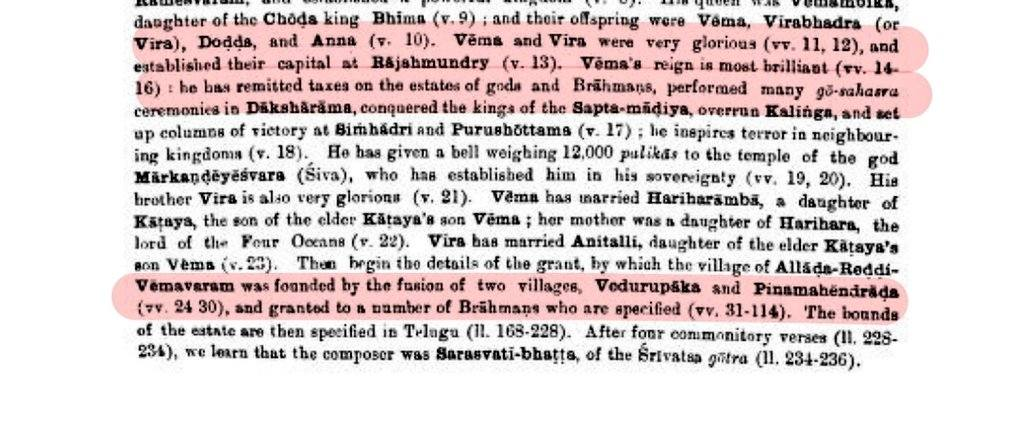
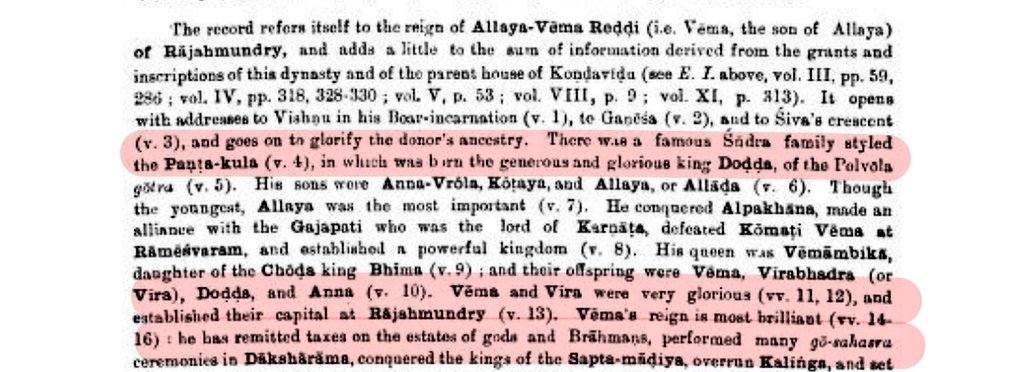
Raja Prolaya Vema Reddy, the founder of the Reddy ruling dynasty, proudly identified himself as a Shudra king, proud of emerging from the divine lotus feet of Bhagavan Vishnu. https://twitter.com/Arya_Anviksha_/status/1756345077780140207 

He restored Agraharas that had been confiscated by Muslim rulers, constructed & restored temples, was a patron of literature & arts, built majestic ports. https://twitter.com/Arya_Anviksha_/status/1428044659389919233 

Today, the Reddy Jati in USA is one of the highest performing, wealthiest & most educated Indian communities.


Raja Chinna Sevappa Nayaka, the founder of the Nayaka dynasty of Thanjavur, also identified himself proudly as a Shudra, in the Raghunāthā-bhyudaya Nātakam and Vijayvilāsam, authored by Ch. Venkatakavi. https://twitter.com/Arya_Anviksha_/status/1756352312832917954 

He built temples, Gopurams, repaired tanks & was generous in charity.


In Andhra, the Kakatiyas with Warangal as the capital are a famous dynasty. The famous Kohinoor diamond was mined during Queen Rudramadevi's reign & adorned as an eye to the Devi temple. Her son, Pratapa Rudra, valiantly resisted the first Islamic invasion of the South by Alauddin Khilji & Malik Kafur. Vijayanagara was later founded by their generals. The Kakatiyas expressed pride in being Shudras, inscribing "Shudras are the best amongst the varnas, as the bravest & purest", proudly claiming descent from the divine feet of Bhagavan. https://twitter.com/Arya_Anviksha_/status/1756354726449361313


Raja Kempegowda, a governor under Vijayanagara, famous for founding the city of Bengaluru, which is now India's most successful tech city, proudly called himself Chaturta (Shudra).

The shame expressed by my senior is more recent, cultivated by the class & caste obsessed Marxist academia, weaponing history through dishonesty & creating a sense of victimhood & hatred. It is only a matter of time before this edifice of lies will crumble before the truth.


Wednesday, February 14, 2024

Vasanta Panchami Saraswati Puja

Happy Vasanta Panchami. This is a day of Saraswati (सरस्वती) Puja.

A rare Saraswati temple exists in Koothanoor, Tamizh Nadu. Many Bhaktas have reported personal experiences of improvements in education after her blessings. This was the deity worshipped by court poet Ottakoothar, a contemporary of Kambar. While Kambar had composed the Ramayana in Tamil, it was Ottakoothar who composed the Uttara Kanda portion in Tamil.


Ottakoothar was the dumb (unable to speak) son of Kumbakonam Sarangapani Dikshidar. He spoke on Vijayadashami with Saraswati's blessings. In Tamil, she is called Then Kani vakadevi or Kalaimagal. Ottakoothar's early composition was the Saraswati Andathi. Andathi comes from the Samskritam Antha-Adi; a poetic form where the end of a verse is linked to the beginning of the next one.

Raja Raja Chozhan would donate a village to Ottakoothar, hence the name Koothanur to the village. This temple was built by Ottakoothar.

Ottakoothar's samadhi is in Veerabhadra temple, Darasuram, behind the Iravatheewar temple. The temple is poorly managed as expected by the government.


Kambar was also a Saraswati Bhakta. She got him out of a fix many times. Here is one famous episode.

The West celebrates the tragic romance of Romeo & Juliet. Bollywood repeatedly references Laila & Majnu. For Tamils, until at least the previous generation, it was Ambikapathi & Amaravathi, the princess (Rajakumari). Ambikapathi was Kambar's dashing son, a poet, composer, musician & a warrior.

Once when Amaravathi walked in the palace on flower petals, Ambikapathi praised her with the phrase: Veitha kaal noga, edutha kaal koppalikka. Meaning the flower petals are so hard that they hurt your feet, the petals are so hot that they burn your feet. The problem: he says this in full public view of the king's session, incensing the king. Kambar lies that there was a granny selling food in the hot sun & that his son was referring to her. The king sends soldiers to check & there is Sarawati, actually taking the form of a granny, making his words come true. 

In Hindu Sampradaya, the divine will ensure that any words uttered by a saint comes true. Hence, Hindus seek out saints & their blessings. The blessing of a saint can thus override Karma.

The Chera king requests Kambar for his Saraswati vigraha & installs it in his capital at Padmanabhapuram. Later, Maharaja Karthika Thirunal moved the capital to Thiruvananthapuram. Every Navaratri from then, she is taken in a royal procession from Padmanabhapuram to Thiruvananthapuram & returned. Nowadays, she even has police gun salutes. However, apart from Navaratri, Kambar's Padmanabhapuram's Saraswati surprisingly gets only a fraction of the visits of Koothanur.


Kites are flown in Vasantha Panchami celebrations.

During India's dark ages, a young saint, Haqeeqat Rai, was killed on Vasantha Panchami after his refusal to convert. The colonial British had imposed restrictions on the festival celebration. In 2007, the government of Pakistan banned the festival.


The Hindu civilization, with the loss of half the territory and loss of generational wealth, faces immense existential challenges. A toxic academia, media & entertainment push misinformation & disinformation in the guise of neutrality, much like Putana. With her blessings & knowledge, all hurdles can be overcome.

Monday, October 09, 2023

Dharma vs Jungle law

Dharmo Rakshito Rakshitaha.

If you protect Dharma, Dharma will protect you.

Nature's default law is Matsya Nyaya. Big fish eats little fish. Also known as Jungle law, where the strong will survive & the weak will perish. The young are ruthlessly hunted.

Humans inherently dislike Matsya Nyaya for the human society. Owing to compassion, we seek to protect the weak & the poor as well. This allows civilization to thrive, by allowing humans to think higher thoughts, philosophy & create beautiful art. This is only possible when survival & safety is guaranteed even if we are weak.

The alternative is a system where everyone, including the powerful rulers, voluntarily subject themselves to common rules governing all. This is one aspect of Dharma. In some Dharmic systems, the powerful subject themselves to even harsher rules.

When not restrained by Dharma, the powerful will prefer a Matsya Nyaya system. The powerful can get away using political & legal loopholes, hiring media, writing propaganda to influence public opinion, hiring top lawyers & assassinating witnesses or dissidents.

There are other systems such as Marxism which, on the surface, look like Dharma, since it professes compassion for the weak, hence the appeal. However, it is a Matsya Nyaya system in disguise, which will end up in Communist dictatorships with special privileges for the party members, ruthlessly suppressing dissent with Kulaks & concentration camps. Religious systems that 'compassionately' seek to save others from a fiery hell after death also end up as Matsya Nyaya systems.

All human societies throughout history will swing between a Matsya Nyaya & Dharma system, ending up somewhere in-between. This conflict is eternal.

It is up to all of us to do whatever little we can to setup a Dharmic system, to protect us all. This is an unfortunately an eternal constant task. No one can do it for us; we all have to do our bit. Else, we will see unpleasant Matsya Nyaya in action.

The price of freedom & civilization is constant vigilance, for there are always barbarians at the gates. Dharmo Rakshito Rakshitaha.

Thursday, July 06, 2023

Martial Arts Rahasya

The worship of BodhiDharma

7amm arivu Tamizh film: https://einthusan.tv/movie/watch/0598/?lang=tamil https://youtu.be/lYGoAZLbZh0 

1-3 minutes. 21-23 minutes.

The origin of Shaolin

BuddhaBhadra. 1st abbot of the Shaolin temple. 

BodhiDharma: 2nd abbot of the Shaolin temple.


https://www.facebook.com/trueindology.org/posts/pfbid027Hctmtn4xUjoCqc4bRrrBDXZqNFQY38snhSy3t7t2YjUCkeEo72FAXzj7nctE4Uql

"This painting from ancient Shaolin temple (China) depicts the Indian monk Buddhabhadra, who was the founder of Shaolin temple and its first priest, teaching martial arts to his Chinese disciple Sengchou.

Buddhabhadra founded the famous Shaolin temple in 496 CE.  According to Chinese primary sources, Buddhabhadra was a Brahman monk from South India who first came to the Chinese capital Luoyang.

The Chinese Emperor Xiaowen offered to provide  quarters inside the royal palace for the Indian monk. But Buddhabhadra declined this offer. He set up an Ashrama on top of Mount Song which later came to be known as Shaolin.

In this painting, the dark skinned Indian man is Buddhabhadra and his Chinese disciple Sengchou learns martial arts from him.

Source: The Bodhidharma Anthology (translation) The Earliest Records of Zen, Jeffrey L. Broughton; The Shaolin Monastery: History, Religion, and the Chinese Martial Arts", University of Hawaii press 2008"

Buddhabhadra came to China on 464 CE and Established Shailon Temple in 496 CE After Preaching Buddhism for 32 Years.

Bodhidharma Was Born in 483 CE.

Marma Kalai

"Indian" Tamizh film on Marma kalai. https://einthusan.tv/movie/watch/0066/?lang=tamil https://youtu.be/rUyVYT0IUyo 3:30-3:50

Ayurveda documentary of demo of goat paralyzed & removal of paralysis. https://youtu.be/uvG_WtRvvOk "Art of Being": Ayurveda documentary by Pan Nalin 


Used for therapy. Originally Acupressure. Later developed into Acupuncture.

The Ban

Pazhassi Raja

https://youtu.be/ccbp0_ZqMBY?t=160 


https://www.youtube.com/watch?v=acJFxAoXYDk 3:02-3:03

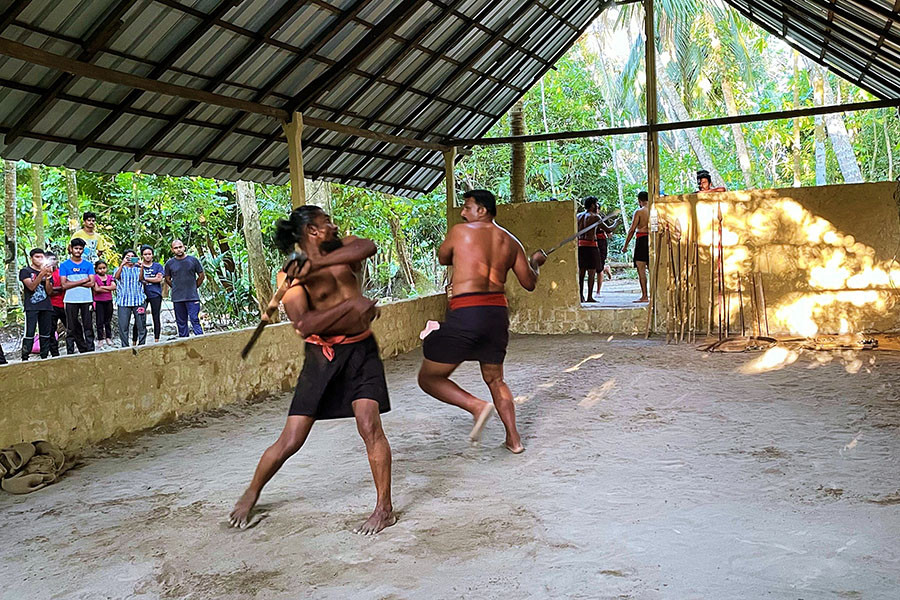
Oral history: Kalaripayattu banned after the Kottayathu war in 1804. No primary English sources on ban. The colonial British burned a lot of records when they left. Many Gurus practiced in secret & came public after India's independence, which is the secondary source for the ban.

Oral & written Sampradaya: KalariPayattu (combat place+fight) founded by Parasurama. 

The Preservation

Gurukulams preserved the Vadakkathan (northern & central) Kalaripayattu art in secret, practicing with trees. Revived after India's independence. 

Shrines (Poothara):

  1. The Ganapathitara
  2. The Ayudhathara, which is dedicated to Shiva (also called Ayudhabairavan)
  3. The Gurutara – a small platform in remembrance of all past Gurus & current Guru.
  4. A small set of seven steps representing the seven chakras. 

Final training: Marma kalai & Rahasya Mantras. Safety precautions taken.

POOTHARA PRANAMAM (SALUTATION OF KALARI PAYATTU)

The seven presiding deities of Kalari comprise the seven steps of the Poothara. 
  1. The first step is that of Vignesha or Ganapathi at the base of the Poothara indicating strength & initiation.
  2. The second step is Chandika or Bhumi or Parvati (Earth Power) giving patience of earth. 
  3. The third step is of Vishnu for Agnisakti or commanding power. Vishnu has the Chakra as his weapon and its rotation destroys all enemies. 
  4. On the fourth step is Vadukisca or lighting. Speed & Posture (Ayudha parasakthi). 
  5. On the fifth step is Tadaaguru the power and blessings of the guru (Gurusakthi). 
  6. And on the sixth step is Kali in her Raudra aspect. Here, you get this special power of fury. 
  7. Finally, at the seventh is Vagastha-purusha where you get the power of voice or sound. Making certain noises, one can terrify the opponent like an animal.
A man who perfectly knows all these seven and keeps his mind always concentrated will be able to have superior Manasakti.

Ashoka film: https://einthusan.tv/movie/watch/1170/?lang=hindi 51:35-53:10

The Myth-Jackie chan: https://youtu.be/V7YYYTSkiJ8 

The Last Legion with Aishwarya Rai, treated the art with respect: https://youtu.be/5HIVRnF2CzE 

Magadheera: https://youtu.be/3M3irOF2ai4 

Adimurai

South Form (Then/Therku): Adimurai. Varma Adi, AdiThadi, Chinna Adi.

Origin: Agasthya. Practiced by Siddhas, Siddha medicinal system.

64 "practical vital spots" (abhyasamarmmangal): used only in danger. Knowledge may be passed down only to a Shiva Yogi. 
Sri Bhadrakali Mantram: chanted without error, can defeat the enemy.

Adimurai movie: Pattas. https://einthusan.tv/movie/watch/27KY/?lang=tamil 1:28:00-1:35:00 Wanted recognition by the Indian government.

Kalaripayattu from Kerala, Mallakhamb of Central India, Gatka of Punjab and Thang-ta of Manipur recognized as a sport in March 2021 by the Indian government. Multiple local indigenous martial arts still struggling & kept alive by a few practitioners. May go extinct without patronage.

AngamPora

SwarnaDvipa / Simhala / Tamraparni (Now called Sri Lanka). Settlers from Kalinga (Odisha). Simhala similar to Oriya.
AngamPora, banned by the colonial British in 1818. Practice punished by gunshot to knee. Preserved in secrecy. This lends credence to the claim of the ban by the colonial British in India.
Ban lifted by the (now independent) Sri Lankan government in June 2022. Colonial legacy persists & it takes time to decolonize.
Practiced in Buddhist shrines. Final rite of passage in a Buddhist temple. Respect to Guru parampara. Includes Marma Kalai.


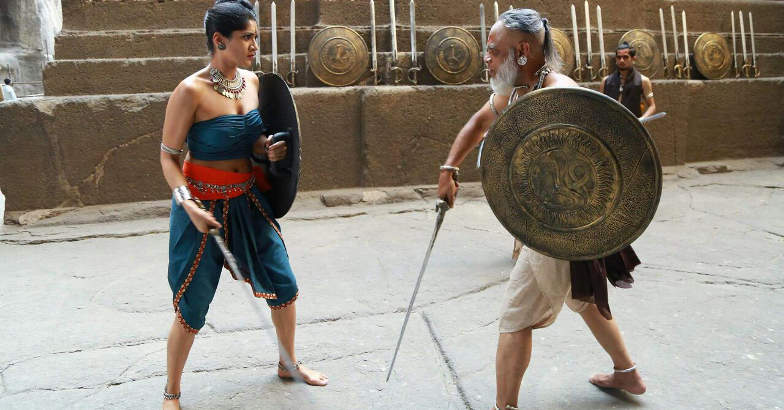
Flexible sword: Urumi

Ashoka film: https://einthusan.tv/movie/watch/1170/?lang=hindi 7:50-8:40 51:35-53:10

Junglee film: Vidyut Jammwal. https://einthusan.tv/movie/watch/95Po/?lang=hindi 1:15:00-1:18:00

Urumi film: https://einthusan.tv/movie/watch/3083/?lang=malayalam 

Panipat film: Sadashiv Rao Bhau practicing with an Urumi. https://youtu.be/zpXnmy-6w1g?t=97

Warriors

Vatakkanpattukal


Chandu Chekavar


Aromal Chevakar

Types of warfare

UpaVedas:
  1. Rig Veda: AyurVeda
  2. Sama Veda: Gandharva Veda
  3. Yajur Veda: Dhanur Veda
  4. Atharva Veda: Artha Shastra & Sthapatyaveda
DhanurVeda:
  1. Close combat: Malla-Yuddha (wrestling), Mushti-Yuddha (boxing, Kusthi/Kutthu). Chanura/Mushtika examples.
  2. Close weapon combat: Amukta. Weapons that cannot be released from the hand. Gadha (mace), KhadgaVidya (sword), Danda (stick)-Silambam, Gatka. 
  3. Range weapons: Mukta
    1. PaniMukta (weapons released by hand). Throwing (spear) & Archer (bow/arrow). 
    2. YantraMukta (weapons released by machines).
  4. MuktAMukta: released with mantras & the power of the mind. Ended with Dvapara Yuga. Kali Yuga humans lack the mental strength.

Arthashastra (salt-petre). All ingredients of gunpowder except Sulphur. Used in rocket warfare. Preserved by the Maharaja of Mysore. Damaged in Independent India.
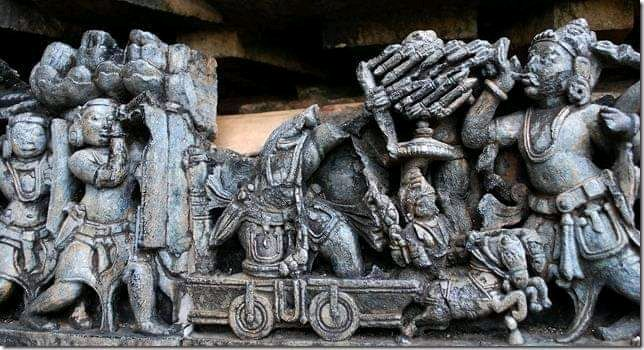
Halebidu temple carving


Crouching tiger/hidden dragon has a scene with a Gadha. https://youtu.be/Hp_KhU2h5XQ?t=114

Ramayana: Anjaneya never uses Gadha. Only Vali & Sugriva knew to use weapons, only PaniMukta like Gadha. Vanaras would fight by throwing rocks, trees & mountains.

Types of war

  1. Achara Yuddha: right type of warfare with rules followed.
  2. Rakshasa Yuddha: Enemy who follows no rules & harms civilians. Vasishta recommends not following Achara Yuddha & following Koota Yuddha instead.
  3. Koota Yuddha: Use strategy, tactics & deception without stooping to Rakshasa Yuddha.
  4. Dharma Yuddha: war to restore & preserve Dharma.

Learning

64 arts includes martial arts that everyone is expected to learn. 

Krav Maga

Invented by Imi Lichtenfeld. Designed for modern combat building & street fighting based on the knowledge of martial arts systems of the world. Special forces train. Do not get hurt during training.

Combat tournaments in the West

Earlier western martial arts tournaments avoided contact. Bruce Lee changed that. Initially preferred Kung Fu. Later, changed philosophy. Be formless, adapt like water.

Firearms

YantraMukta: recommended to learn. Safety precautions to be taken, as in Marma Kalai training. Women now have the ability to protect themselves against much stronger foes with minimal training.

Wednesday, March 01, 2023

A political agenda to fulfill a vaccuum in India

Currently, there's a vaccuum on certain issues that politicians are afraid or unwilling to handle. There is a political opportunity for whoever can seize it, by promising the following agenda. 

  1. Repeal RTE (Right to Education) Act that is forcing Hindu schools alone to conform to onerous regulations, resulting in their shutting down.
  2. End reservations.
  3. Repeal 498a.
  4. Amend Waqf board act to reduce its powers
  5. Regain church land. End Hindu tax payer funding to religious schools, which will hit the church & madarassas.
  6. Dissolve the minority commission.
  7. Repeal the SC/ST act.
  8. Allow terrorized victims to bear arms legally in the Red Corridor, Kashmir & Mizoram/Meghalaya.
  9. Free Hindu temples from govt control
  10. Dissolve Supreme Court collegium. Have the parliament nominate & ratify appointments similar to USA.
  11. Don't allow courts to postpone or stay cases unless there is severe sickness or death of the plaintiff, defendant or judge.
  12. Revoke communist labor laws. Make the entire country a SEZ (Special Economic Zone) instead of a pocket.
  13. Make freedom of speech absolute. Have a high bar for libel. Revoke 'hurting religious sentiments of people' laws.
  14. Legalize citizen spying for corruption. Share recovery with whistleblowers.
  15. Revoke places of worship act.
  16. Revoke licenses of NGOs & foreign media.
  17. Severe punishment for littering. Japan & Singapore implemented this severe punishment resulting in cleanliness.
Even winning some seats with this agenda can help.

Wednesday, February 15, 2023

India's biggest problems

Observations on the biggest problems of India in order of priority that the leadership is afraid of tackling.
  1. Waqf board land-grabbing & judicial extraordinary powers. Now 2nd largest landowner in India. Powers granted by PV Narasimha Rao & Jawaharlal Nehru governments. Tackling will lead to riots & push-back by the 2nd most powerful global power: Islam. 
  2. Church land grabbing. Originally leased by the colonial British. Now the largest landowner in India. Tackling will result in pushback by the most powerful global power: Christianity.
  3. Reservations. Mired Indian society in mediocrity, deepening fault lines & hatred against the native Hindu culture, traditions & religion. Pushed through by Ambedkar with a time limit of 25 years that is now indefinite & worsened by Vishwanath Pratap Singh. Tackling with result in riots & push-back by the two of the three most powerful global powers: Communism & Christianity.
  4. No-go areas, Intolerant demographic change, rioting & Ethnic cleansing: Needs heavy funding, powerful policing & an end to no-go areas. Restoration of rights & properties of Kashmiri Hindus & Bru Mizoram Hindus. Article 370 & 35A revoked but remaining Kashmiri Hindus still terrorized. Problems are the Red Corridor (Communism, Maoism, Naxalism), Kashmir (Radical Islam), Mizoram/Nagaland (Radical Christianity). 
  5. Minority commission: Special rights for global powers of Christianity & Islam. Setup by the Manmohan Singh/Sonia Gandhi govt. States where Hindus are a minority deny the minority status to Hindus to deny them govt aid. Idea comes from Communism which uses western models to presume that majority oppresses minority.
  6. SC/ST Act: Guilty under proven innocent draconian law passed by Vishwanath Pratap Singh. Order to dilute by the Supreme Court overturned by the government under threat of violence & loss of power. Tackling will be opposed by Communism.
  7. 498a: Passed by Indira Gandhi. Guilty until proven innocent law that devastates husbands & their extended families. Devastates the family structure. Tackling will be opposed by the feminism wing of Communism.
  8. RTE: Right to Education Act applicable only to Hindu schools with onerous regulations forcing them to shut down.
  9. Government control of Hindu temples: Communist, Evangelist & Islamic governments control only Hindu temples interfering with its function, tax & loot the temples impoverishing the temples. Setup by the colonial British.
  10. Collegium: Supreme Court Justices elect themselves. Setup by the colonial British only in India to ensure judges loyal to the British but not implemented in Britain.  Takes huge breaks, capricious & hears frivolous cases. Will be opposed by the Supreme Court losing its powers.
  11. Legal backlog: Hearings keep getting postponed or stayed. Can be solved by a simple rule used by a Pakistani judge. No postponements unless there is a severe sickness or death of plaintiff, defendant or judge.
  12. License-permit Raj & labor laws: Socialist communist system that is a nightmare for new businesses & closing businesses a bigger nightmare. Communist labor laws circumvented with SEZs (Special Economic Zones) & some legal convolutions fixed. But needs a lot more work.
  13. Bullying by foreign powers seeking break-up of the nation to control smaller states: Can be achieved by fixing internal problems & boosting the economy. 
  14. Colonial system: Genociders glorified, worshipped, have cities & roads in their name owing to colonial history. State looks to fix the natives instead of serving them. High courts & the Supreme Court require English to deliver justice. Higher education requires English. Imposed by the colonial British. Results in mental colonization & looking down on native cultural wisdom.
  15. Corruption: Worsened by a continuation of the British colonial systems. No easy solutions. Maybe temporarily weaken privacy laws, strengthen whistle-blower laws & enable citizen spying & journalism. Add incentives by sharing corruption recovery funds with the whistle-blowers.  
  16. Cleanliness: Can be fixed by punishment for littering as in Singapore & Japan, & less corrupt waste management. Waste management contracts are given to political contacts, spending a large amount of public money for the poorest service.
  17. Places of worship act: Passed by PV Narasimha Rao govt. Denies Hindus from reclaiming any of their demolished holy shrines. Goes against principles of natural justice. Law not enforced when demolishing Hindu shrines for 'development'.

What would be your list in order of priority?

Tuesday, February 14, 2023

Seeding Worlds: How Life Transformed Venus and Unveiled the Mysteries of Earth's Origins

In the early years of the 22nd century, humanity faced an unprecedented threat. The CO2 levels in the Earth's atmosphere had reached catastrophic levels, and scientists knew that if nothing was done, the planet would soon become uninhabitable. In a desperate move to save their home, they turned their attention to the neighboring planet of Venus, which was known for its extreme heat and thick clouds of CO2.


A team of scientists developed a plan to populate Venus with thermophiles and tardigrades, two resilient types of organisms that could survive in the planet's harsh conditions. They designed special capsules that could withstand the heat and pressure of Venus, and loaded them with the organisms before launching them towards the planet.


The capsules landed on Venus and released the organisms, which began to multiply and thrive in the hot, hostile environment. Over the years, as the organisms grew and adapted, they started to produce oxygen, gradually reducing the CO2 levels in the planet's atmosphere.


Meanwhile, on Earth, scientists had developed advanced carbon capture technology that could capture CO2 and store it safely. They discovered that the technology could be powered by heat energy, and began to tap into the geothermal resources of the planet to power their machines.


As the carbon capture technology improved, scientists realized that it could be used on Venus to accelerate the process of reducing CO2 levels. They designed special machines that could orbit the planet at low altitudes, using the heat of Venus to power themselves and capture carbon. The machines gradually reduced the CO2 levels on Venus and generated oxygen, which began to transform the planet's environment.


Over the centuries, the temperature on Venus began to drop, and the planet became increasingly habitable. Multiple carbon capture machines were seeded across Venus, capturing carbon rapidly and emitting oxygen. The Venusian CO2 clouds started clearing, and the temperature started reducing to earth levels over a few centuries.


Finally, humans were able to travel to Venus and explore its new, transformed environment. But they soon discovered that the higher radiation levels made it difficult to live on the planet without protective gear. Nonetheless, they marveled at the stunning beauty of the planet and the incredible progress that had been made.


Scientists on Venus began to study the organisms that had been seeded on the planet, and discovered that they had evolved into new, different forms. They continued their research, trying to understand the evolution of life on Venus, when one scientist made a stunning discovery.


Through his research, he found evidence that Earth had once been seeded with similar organisms, thermophiles and tardigrades, and that humans had eventually evolved from them. This revelation sparked a new era of scientific inquiry, as researchers around the world tried to unravel the mysteries of their own origins.


As humanity continued to explore and transform the universe around them, they were left with an open question - who had seeded Earth, and for what purpose? The answer remained a mystery, but it didn't stop humans from looking towards the future with hope and wonder.

Sunday, December 11, 2022

Indian support for France: a historical political overview

Sometimes, sports is influenced by politics & history. Some Indians cheered France over England in the football world cup.

Understandable since memories of British colonization & their impoverishment of India while starving the people to death are still fresh. However, the French East India company had also colonized parts of India.

In Puducherry (Pondicherry), the Vedapureeshwarar Shiva temple was desecrated with filth with filth also thrown on devotees & finally demolished by the French East India company. This was led by the Governor's wife, Madame Dupleix & the priest of Karaikal, Coeurdoux. The Immaculate Conception Cathedral was built on top. 

This is cautionary tale on blindly following woke feminism, which blindly argues for reservations for women, which countries like India have implemented reserving legislative seats for women. There are women like Ahilyabai & Chennamma on one hand who exhibit the highest feminine qualities, and women like Dupleix who exhibit the worst qualities. Later, Kandappa Mudaliar reconstructed the temple at a new location with public funds.

French colonization was brutal throughout the world. The Mission civilisatrice (civilizing mission) was intended to spread their language & religion, openly proclaiming a 'duty to civilize the inferior races'.

In any problematic relationship, things are good as long as the victim remains silent or praises the perpetrator. Openly discussing the problems would reveal the true nature. A good test of character would be asking for reparations & seeing the reaction. Maybe even something as simple as requesting a Vedapureeshwarar temple replica in France as atonement. Or even restoring Notre Dame as a place of worship to the excavated Vulcan & old religion deities to atone for their own historical persections. Will the virtue-signaling of Liberté, égalité, fraternité melt away quickly?

Monday, November 14, 2022

The unbaked pot

Gora Kumbhar, the potter had a few guests. The four siblings, Nivritti, Gnaneshwar, Sopan & the little sister Mukta Bai had arrived, along with Namadevar.

The little Mukta, the embodiment of Shakti, decides on a small Leela (play) & asks the old potter.

"How do you make pots?"

"Just as Panduranga makes everything & everyone as pots from the 5 elements of earth, water, fire, air & space, I make pots from just earth".

"How do you decide if the pot is correctly baked?"

"I hit it with a stick & listen to the sound".

"Can you also hit us, the pots of Panduranga, with this stick & see if we're baked or unbaked? Please Mama (uncle), Please. My brothers first."

Gora Kumbhar gently taps a smiling Nivritti, Gnaneshwar & Sopan.

"Please tap me, please..."

Gora Kumbhar gently taps a giggling Mukta. Namadevar is just sitting aloof.

"Mama, please tap Namadevar Mama as well."

Gora Kumbhar hesitates. Namadevar doesn't seem too approving.

"Oh please, tap him as well."

Gora Kumbar taps Namadevar, who explodes in rage. "What kind of a stupid game is this?"

Now, Mukta says: "Oh, so this is the unbaked pot!"

With a face blackened with anger & humiliation, Namadevar storms out, ignoring Gora Kumbhar's apologies & explanation that he was only humoring a child.

He repeatedly complains to Panduranga. "Me, your Bhakta, who is constantly singing your names & your glory, how could I be subject to such humiliation?" When normally he would get a response, he gets only a surprising silence. Dejected, when he goes to take his life, finally he gets a response. "It is you who has humiliated my Bhakta, Gora Kumbhar by storming out when ignoring him. And Mukta is right; you are an unbaked pot. Find yourself a Guru & get yourself ready."

And Namadevar goes in search of a Guru. (Read that story here.)

Monday, October 10, 2022

Ponniyin Selvan I - historical musings

The movie keeps referring to Sri Lanka as Lanka (Ilangai). This name is fairly recent. The right name should have been SwarnaDvipa, Tamraparni or Simhala. Simhala was populated by people from Kalinga (now Odisha). Sinhala is Samskritam based & still has similarities to Odisha. https://bharatbhumika.blogspot.com/2015/11/geography-of-ramayana.html

The movie accurately refers to Ashoka's daughter respectfully in Simhala. After Ashoka converted to Buddhism, his children become missionaries. Sanghamitra does go to Simhala & the people convert to Buddhism under her influence. However, the Mauryan empire collapses after Ashoka.

In war scenes, the warriors are not wearing war helmets that protect the nose. In a beach battle, ArulMozhi is wearing a turban. In the middle of a battle, he removes his turban. I understand that actors are paid for their expressions & the need to show them to the audience. A better way would be to show the war helmet getting knocked off in battle. Gowarkar does this well in Panipat. 

Also, in the beach battle, the Chozha army is shown coming ashore while the Sinhala army is waiting. Either the ships need projectile weapons to provide covering fire to the boats coming ashore, or the soldiers need to come ashore in stealth. Else, the beach landing will fail. This battle could have been better thought through. Also, an unarmed ArulMozhi swimming to the enemy ship while they were watching would be easily captured. It was unrealistic to show him climb unarmed & then defeating multiple warriors.

Sundara Chozhan is shown as being treated with acupuncture by Chinese physicians. Varma Kalai, a part of Hindu martial arts like Kalari Payattu, used acupressure. This was introduced to the Shaolin temple by Buddhabhadra who founded it in 496 CE, the 1st abbot & later by Bodhidarma, the 2nd abbot. The acupressure martial arts techniques were later developed into acupuncture by the Chinese. But this would have taken multiple centuries. It seems incongruous to show this treatment in the movie. The director could have shown acupressure or some kind of oral medicine. https://www.facebook.com/trueindology.org/posts/this-painting-from-ancient-shaolin-temple-china-depicts-the-indian-monk-buddhabh/1134417563425428/


Friday, October 07, 2022

Ponniyin Selvan I - movie review

If you are willing to overlook the now normalized anti-Brahmin Hinduphobic subliminal messaging in Tamizh movies, the movie is a decent adaption of the writing. Kalki's plot is imaginative, intricate & sprawling, with multiple characters, with adventure, thrills, subterfuge, mystery, action, drama & romance. It has all the NavaRasas. Owing to its scale, people tried & failed to make a movie out of it, since releasing a movie as multiple parts wasn't an idea back then. The story is better suited as a TV series. As a movie, the narrative is linear & some characters were either removed or relegated to small roles.

The make-up artists did a great job. The relatively old Aishwarya & Trisha still look good. The art is good. The music is decent with decent songs & good back-ground music. The lyricist who wrote the Murugan song wonderfully using the Tamizh name of Seyyon while using Thiruppugazh like lyrics. Arunagirinathar pioneered using words with specific sounds to indicate the end of phrases or a beat in the Thiruppugazh which was used here. It was lovely to hear the old Tamizh. The actors did a good job. It was nice to hear Vedic chants & Vetrivel.

Now, to the bad.

In the book, Azhwarkadiyan Nambi is an intelligent spy sent by ArulMozhi Verman. The banter between Nambi & VanthiyaDevan is sharp but respectful & good-natured. But Tamizh cinema & literature has been caricaturing Brahmins for decades now. When was the last time you saw a positive Brahmin character in a Tamizh movie? The movie converts Nambi into a buffoon. He is called derogatory names, repeatedly assaulted & water-boarded by VanthiyaDevan in an attempt at humor. His sacred thread is cut & he complains like a buffoon. In the light of Dravidar Kazhagam folks boasting on video on physical attacks on Brahmins with quotas on cutting their sacred thread and repeated physical attack recorded, this continues normalizing brutalizing Brahmins as subliminal messaging. He could simply have stuck to the story & character as represented by the author.

Madurantakan, the Shivan Adiyar, says that he will no longer follow Shiva & rips off all his Rudraksham Malai. Why this explicitly Hinduphobic scene deviating from the book?

Devars are Maha-Muruga Bhaktas. They will have the Vibhuthi Thiruneer & Kungumam always. Not having it means that someone has passed away in the family. They also had a unique hair style in those days. Vanthiya Devan has a bare forehead & the current day Western hair cut.

ArulMozhi Verman, who called himself Siva Pada Sekaran does not have the Thiruneer Vibhuthi is all scenes. He is also not wearing the sacred thread.

The dialog delivery of Vikram & Aishwarya's dubbing artist in SenTamizh was wonderful. All others struggled. The previous generation actors were fluent in SenTamizh. In just one generation, that skill seems to have gone. Many English educated Tamizh people can no longer even read Tamizh, let alone write it. Independent India has been a disaster in increasing mental English colonization & subjugating its native languages. Some Indic languages have already gone extinct. It is only going to get worse from here.

In an early trailer, it said: Ponniyin Selvam rather than Selvan before it was pulled. Lack of attention to detail.

The lead actors cast were too old for the actual characters in the story. ArulMozhi Verman was a mere 19 year old boy in the story. The casting could have been better. This could have launched some young careers.

From people who haven't read the book, I heard that the pace is quick & hard to follow. You need a background to understand the movie. But then, the mystery of certain acts would be lost.

The song on Murugan had interesting art & costumes. But it depicted the Chozhas, the patrons of high culture, somewhat semi-barbaric.

The actress playing Vanati is highly flexible & a good dancer. But wasn't good looking enough to play the future Rani (queen).

I wish that Tamizh cinema had directors with the skill of KS Gopalakrishnan who could make Dharmic movies. ManiRatnam is a decent director who has done a decent job but has chosen to de-Hinduize & add anti-Brahmin elements to the film to the extent possible. VetriMaran & KamalHassan, both excellent in the film profession, have chosen to publicly display their ignorance of history, showing how deep the Marxist-Missionary propaganda has been internalized. This is a reminder that excellence in one field does not mean knowledge in another.

In Marxist strategy, it is important to capture education through academia, entertainment & media. Once captured, in just two generations, per Marxist theory, the commoners can be taught to hate their ancient culture & follow Marxism. ManiRatnam's son, Nandan, was a star at a Communist party meet where he publicly admired Marxism & wrote a paper on Leninism. He now studies theology in Christ college. A classic Marxist-Missionary product. The apple doesn't fall far from the tree.

Wednesday, September 21, 2022

From the Purusharthas to Financial Security-Talk outline

Part I:
  • Disclaimer
  • FIRE, Fat FIRE (better lifestyle), Lean FIRE (Frugal), Coast FIRE (continue working), Barista FIRE (low-stress low-income job)
  • Basic Security
    • No High-interest debt
    • 1 year emergency fund
  • Lend
    • How Banks make money
    • Lock-up money
      • Savings/Money Market
      • CD laddering
      • Brokered CDs
    •  Bonds
      • I-Bonds
      • Bonds vs Bond mutual funds
        • Expenses & load
        • Govt vs Corporate, duration, tax-free (CA municipal vs US govt), US vs international vs emerging, hedged vs unhedged.
    • P2P: Prosper. (LendingClub shut down).
    • Real-Estate hard loans for accredited investors. Flippers open new biz for every flip, OPM.
  • Invest
    • Stock
    • Long vs Short
    • Derivatives
    • Hedging
    • Mutual Funds: Open vs Closed, Active vs Passive Index, Stock vs Bond vs Balanced, US vs International vs Emerging Markets vs World
    • Diversify: Total World Stock, Target Retirement Funds. Investment theory: stocks over long term. Exceptions like Japan.
  • Employee Plans
    • ESPP
    • ESOP in a startup: 83b early exercise option
    • RSUs
    • 401k, Roth 401k: early withdrawal penalty
    • Rollover IRA: Direct rollover & indirect rollover
  • Defer taxes
    • IRA, Roth IRA, 10% penalty
    • 529
  • Credit card rewards
    • Cash back: flat-rate vs rotating rewards
    • Points
    • Benefits like trip insurance, rental car
    • Paid vs free (primary rental car insurance)
    • Extended Warranty
  • Business
    • Expenses after tax vs biz expenses before tax
  • Will vs Trusts (Probate doesn't include liabilities, but increases administration work)
  • Annuities
  • Life Insurance
    • Returns (eg: term life, permanent life[whole, variable universal, universal])


Part II:
  • Is it ok to make money?
  • Asceticism vs money/power/fame/social status.
  • Purusharthas
  • Artha
  • Artha Shastra
    • Vidura Neeti: 5 strengths
      • Physical
      • Good advice
      • wealth
      • family, lineage & social capital
      • intellect
    • Saraswati, Lakshmi, Shakti worship
  • Asceticism
    • Drithirashtra's envoy to Yudhishtira & Yudhishtira's response
    • Types of asceticism
      • Uncha Vriddi: Thyagarajar
      • Staying home: Muthuswami Dikshitar
      • Pattinathar & Pathragiriyar
  • Charity
    • Daily practice: Some food. Tirumoolar's Tirumanthram.
    • Trigunas
      • Nine types: Padma Purana
    • Charity to the undeserving.
    • Deham vs money.

Wednesday, August 24, 2022

Bhajanai (Bhajan) beginning-Haridas Giri

प्रह्लादनारदपराशरपुण्डरीकव्यासाम्बरीषशुकशौनक भीष्मदाल्भ्यान्।

रुक्माङ्गदार्जुनवशिष्ठविभीषणादीन् पुण्यानिमान् परमभागवतान् नमामि॥

prahlāda nārada parāśara pundarīka,
vyāsa ambarīsha śuka śaunaka bhīṣmadālbhyān
rukmāngada arjuna vasiṣṭha vibheeshanadi
puṇyānimān parama bhāgavatān smarāmi